5 Common Mistakes That Are Quietly Damaging Your Skin Barrier
You might be undoing your entire barrier-first routine without realizing it. Here’s what to watch for — and how to fix it.
We’ve spent this entire series building toward something simple: a routine your skin can actually trust. We’ve covered what the microbiome is, how to structure an AM/PM routine around it, and how to choose between prebiotics, probiotics, and postbiotics. But here’s the uncomfortable truth dermatologists keep running into — most barrier damage isn’t caused by a lack of good products. It’s caused by a handful of everyday habits that quietly chip away at progress, often without the person doing them realizing anything is wrong.
This final installment is about those habits. Spot even one or two of these in your own routine, and fixing them might do more for your skin than any new serum ever could.
Mistake #1: Over-Cleansing and Over-Exfoliating
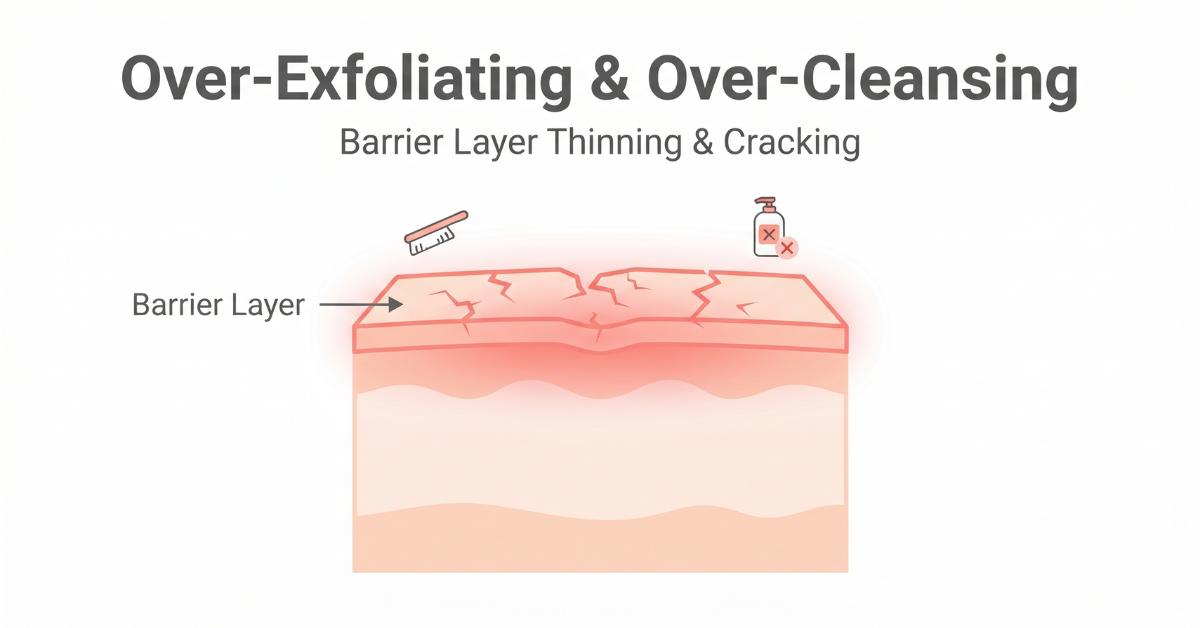
This is, by a wide margin, the most common barrier-damaging habit dermatologists see. The instinct to “deep clean” or chase a perfectly smooth, exfoliated texture is understandable — but skin isn’t a surface that benefits from being scrubbed raw. Each wash with a harsh, high-pH cleanser, and each overly aggressive exfoliating session, strips away part of the lipid matrix holding your barrier together.
The fix is almost disappointingly simple: cleanse once or twice daily, maximum, with a mild, non-stripping formula, and treat exfoliation as an occasional tool rather than a daily ritual. If your skin currently feels tight, reactive, or rough, stepping back to a gentler cleansing routine is often the single fastest way to start seeing improvement.
🌿 FIX #1
Gentle, Non-Stripping Daily Cleanser
Formulated with a skin-friendly pH and humectants like glycerin and hyaluronic acid, this cleanser removes makeup, SPF, and daily buildup without stripping the lipids your barrier depends on — exactly the kind of swap dermatologists recommend first when barrier damage shows up.
Check Current Price on Amazon →Mistake #2: Layering Too Many Actives at Once
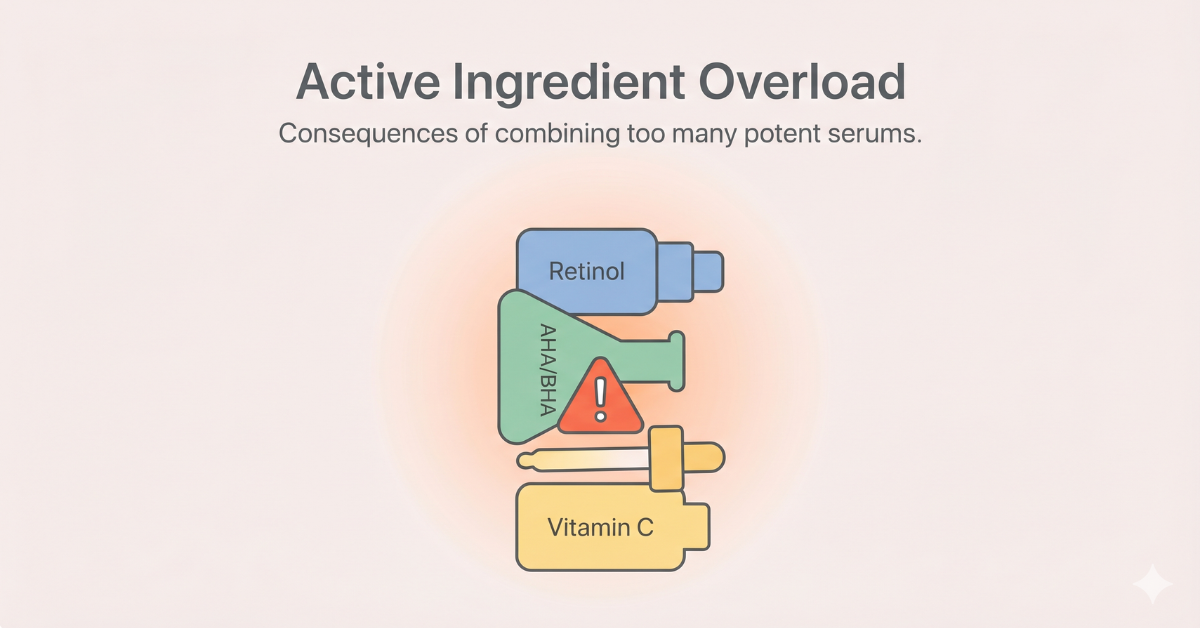
Retinol on Monday, an AHA peel on Tuesday, vitamin C every morning, a new “brightening” serum thrown in for good measure — it’s a routine built with good intentions and a recipe for irritation. Each active ingredient places its own demand on your skin, and stacking several at full strength rarely allows any of them to work properly. Instead, skin ends up in a constant low-grade state of inflammation, which actively undermines microbiome balance and barrier integrity.
The smarter approach is sequencing, not stacking: introduce one active at a time, give your skin one to two weeks to adjust, and alternate strong actives with barrier-supportive “recovery nights” rather than using everything every single day.
Mistake #3: Skipping Sunscreen — Especially on Cloudy Days
This one deserves its own spotlight because it’s so often dismissed as optional. UV exposure is one of the single biggest threats to barrier integrity — degrading lipids, accelerating water loss, and disrupting the delicate microbial balance sitting just above your skin’s surface. None of that pauses because the sky looks gray.
A broad-spectrum SPF 30 or higher, applied every single morning regardless of weather, isn’t a vanity step. In a barrier-first framework, it’s arguably the single most protective thing you can do daily — more impactful, in many cases, than any serum in your routine.
💡 Worth remembering: A compromised barrier is more vulnerable to UV damage, not less — meaning the days your skin feels most reactive are exactly the days sunscreen matters most, not the days to skip it.
🌿 FIX #3
Broad-Spectrum Mineral Sunscreen
A gentle, broad-spectrum mineral formula designed to protect even sensitive or currently-reactive skin without adding irritation. Since UV exposure is one of the fastest ways to undo barrier progress, this is the step most worth never skipping — rain, shine, or anything in between.
Check Current Price on Amazon →Mistake #4: Switching Products Too Quickly to Judge Results
Barrier repair operates on a biological timeline, not an impatient one. Most people see initial relief from tightness or irritation within a few days, visible improvement in redness and flakiness within one to two weeks, and full barrier restoration somewhere around the four-week mark as skin cells complete their natural renewal cycle. Abandoning a product after three or four days — long before it’s had any realistic chance to work — means constantly restarting that clock and never actually completing a repair cycle.
If you’re genuinely rebuilding a damaged barrier, give a simplified routine a minimum of two to four weeks before judging whether it’s working, changing only one variable at a time so you can actually tell what’s helping.
Mistake #5: Picking, Scrubbing, or “Helping Along” Flaky Skin
When skin starts to flake or peel during barrier repair, the instinct to manually remove that texture — picking, scrubbing, or using a washcloth to “speed things along” — is one of the most common ways people accidentally restart the damage cycle they’re trying to escape. That flaking is often the visible sign of skin cells that haven’t finished their natural turnover; physically forcing them off interrupts that process and can reopen the very micro-injuries you’re trying to heal.
The better move, as uncomfortable as it feels, is to leave it alone: keep the area moisturized, stay consistent with your gentle routine, and let the skin shed on its own timeline.
How to Fix a Damaged Barrier: The Reset Checklist
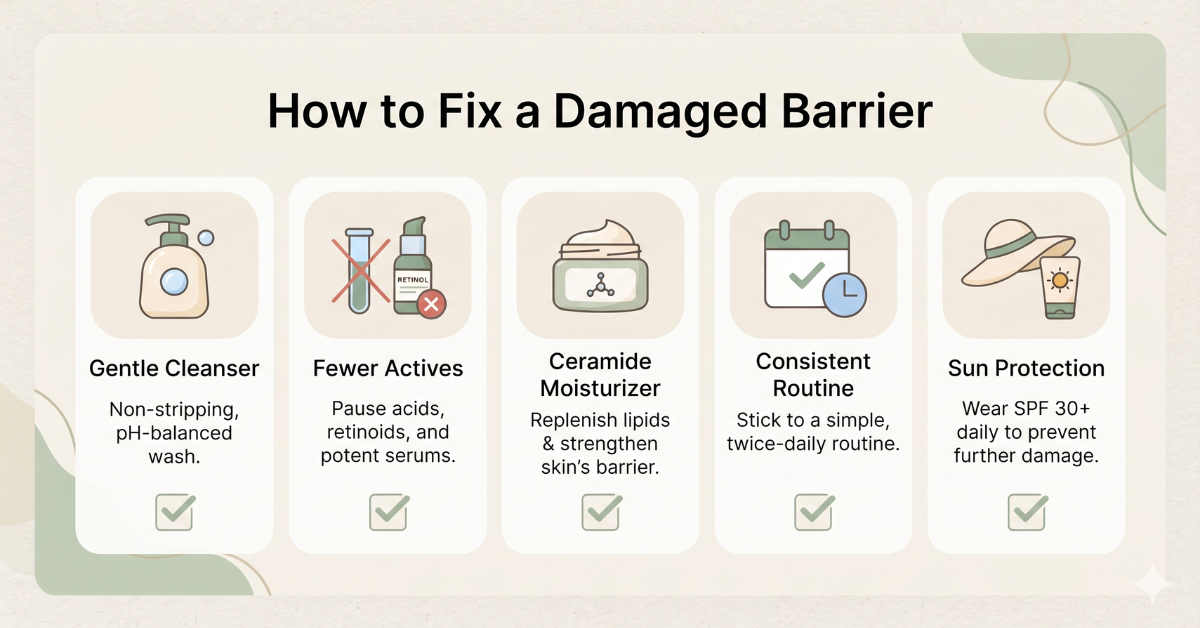
If more than one of the mistakes above sounds familiar, the path forward isn’t complicated — it just requires temporarily simplifying everything:
- Strip your routine down to a gentle cleanser, a ceramide-based moisturizer, and daily sunscreen for two to four weeks.
- Pause all exfoliants, retinoids, and strong acids until tightness, redness, and sensitivity have meaningfully improved.
- Resist the urge to add anything new just because skin feels “better” after a few days — give the full reset window time to finish.
- Reintroduce actives one at a time, a few nights a week, buffered with a barrier cream, once skin feels genuinely comfortable again.
🌿 RESET ESSENTIAL
Ceramide Barrier Repair Cream
Built around ceramides — the lipids that make up roughly half of your skin barrier’s structure — this cream is designed to be the anchor of a simplified reset routine. Rich enough to seal in hydration, gentle enough to use daily while skin recovers, and the kind of product dermatologists return to again and again for genuine barrier restoration.
Check Current Price on Amazon →Bringing the Series Full Circle
Across this four-part series, we’ve moved from understanding what the skin microbiome actually is, to building a real AM/PM routine around it, to learning the ingredient science behind pre-, pro-, and postbiotics, and now to the everyday mistakes that can quietly undo all of it. If there’s one thread running through all four parts, it’s this: a healthy barrier doesn’t come from doing more. It comes from doing less, more consistently, with a clearer understanding of what your skin actually needs at any given moment.
That’s the entire philosophy behind barrier-first skincare — and now you have the complete framework to put it into practice.
📚 Barrier-First Series
- ✅ Part 1: What is the Skin Microbiome?
- ✅ Part 2: Building a Barrier-First Routine (AM & PM)
- ✅ Part 3: Postbiotics vs Probiotics vs Prebiotics
- ✅ Part 4: Common Mistakes That Damage Your Barrier (you’re reading this — series complete!)
💡 Frequently Asked Questions (FAQ)
Q1. How often should I really be cleansing if my barrier is compromised?
Once or twice daily, maximum, with a gentle, non-stripping cleanser. Washing more frequently, or using a harsh, high-pH formula, removes the lipids your barrier needs to stay intact.
Q2. Is it safe to skip sunscreen on cloudy or indoor days?
No. UV rays penetrate cloud cover, and they continue to degrade barrier lipids and disrupt microbiome balance regardless of visible sunlight. A daily broad-spectrum SPF remains one of the most important barrier-protective steps.
Q3. How long should I wait before deciding a product isn’t working?
Give any new product at least two to four weeks before judging its effectiveness. Initial relief from tightness can appear within days, but full barrier restoration follows the skin’s natural renewal cycle, which typically takes about four weeks.
This article is for educational purposes only and is not a substitute for professional dermatological advice. If you have persistent skin concerns, please consult a licensed dermatologist. This post contains affiliate links; WellbeingPrime may earn a commission from qualifying purchases at no additional cost to you.
Stay dewy! 🌿 Bookmark WellbeingPrime.com for more evidence-based wellness guides.
🌿 Weekly wellness, health & beauty insights — straight to your inbox
Free subscription · Cancel anytime