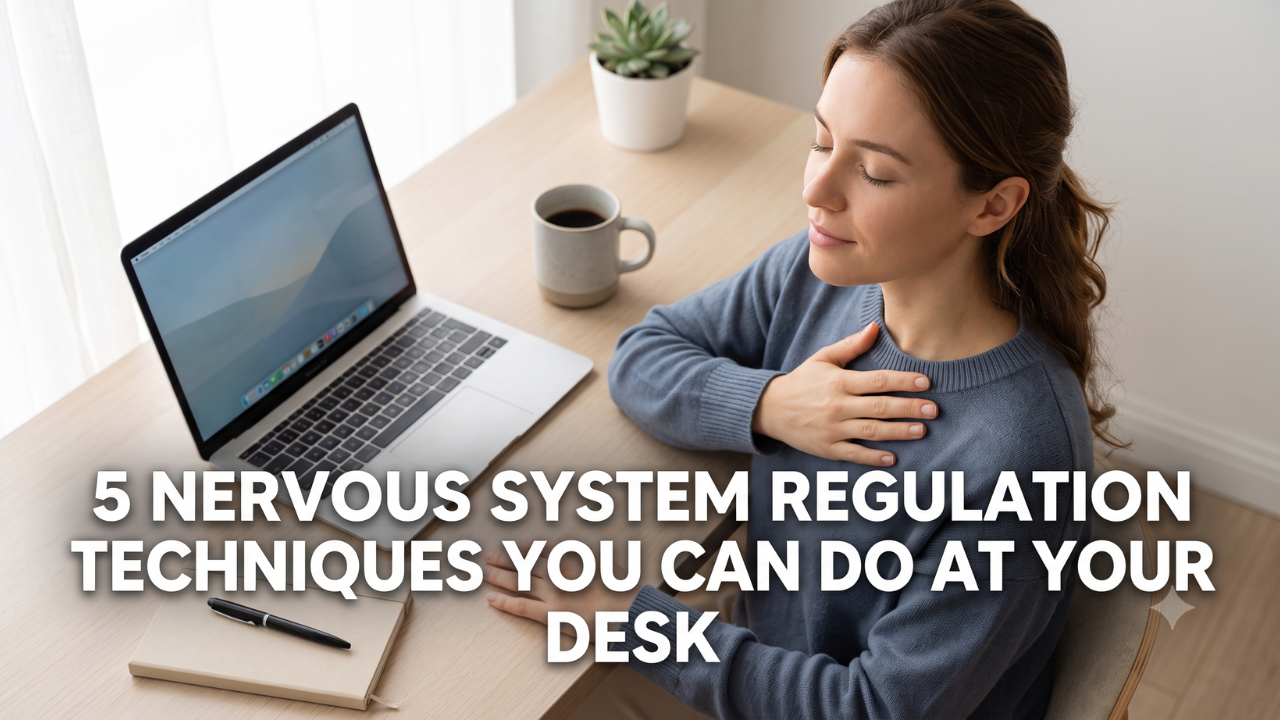
5 Nervous System Regulation Techniques You Can Do at Your Desk
Evidence-Based Micro-Resets for the Modern Workday
There is a particular kind of tired that has nothing to do with how much sleep you got. It shows up around 2 p.m., somewhere between your fourth Slack notification and your inbox refusing to hit zero. Your jaw is tight. Your shoulders have quietly migrated toward your ears. You are technically sitting still, but your nervous system is running a marathon it never agreed to.
Here’s the part most productivity advice misses: you cannot think your way out of a dysregulated nervous system. Willpower does not lower cortisol. But your body has an entire toolkit for this, and almost none of it requires leaving your chair. Below are five techniques — each grounded in real physiology, not wellness folklore — that you can run in under two minutes without anyone at the next desk noticing.
Jump to a Technique
1. Physiological Sigh · 2. Box Breathing · 3. Cold Water Reset · 4. Humming · 5. Shoulder & Neck Release
A quick note before we start: these techniques calm the acute stress response. They are not a substitute for addressing chronic burnout, sleep debt, or a genuinely unsustainable workload — think of them as excellent first aid, not a cure.
Why Your Desk Is Quietly Hijacking Your Nervous System
Your autonomic nervous system runs on two main settings: sympathetic (“go, scan, defend”) and parasympathetic (“rest, digest, repair”). A single stressful email doesn’t just stay in your inbox — it raises heart rate, tightens the diaphragm, and nudges cortisol upward. The problem with desk work isn’t that any one input is dangerous. It’s that the inputs never stop, and your body has no built-in cue to switch back to parasympathetic mode. Standing up to get coffee doesn’t do it. Scrolling your phone during a “break” almost certainly makes it worse, since it keeps feeding the same vigilant, scanning state that got you activated in the first place.
This matters more than it sounds like it should. Sitting in a low-grade sympathetic state for eight hours a day, five days a week, isn’t neutral — it’s cumulative. Your body doesn’t distinguish well between “a lion is chasing me” and “my manager just replied in all caps.” Both trigger the same cascade: elevated cortisol, shallow chest breathing, tightened shoulders, a narrowed field of attention. Over weeks and months, this baseline activation becomes the norm rather than the exception, and that’s when people start describing themselves as “wired but tired,” unable to relax even after the workday technically ends.
What actually flips the switch back is deliberate, physical signaling to your brain that the threat has passed. That’s what every technique below is designed to do — not distract you from stress, but directly interrupt the physiological loop that’s keeping it running. None of them require special equipment, privacy, or more than about ninety seconds.
Support Your Stress Resilience
Cellular energy and stress resilience often start at the mitochondrial level. Liposomal NAD+ is one of the more talked-about options for supporting daily energy and recovery.
Explore Liposomal NAD+ →1. The Physiological Sigh

If you only remember one technique from this list, make it this one. Stanford researchers found that a specific breathing pattern — two inhales through the nose (a short one, then a slightly longer one), followed by one long, slow exhale through the mouth — was more effective at reducing physiological arousal in real time than standard mindfulness meditation or box breathing when practiced briefly and repeatedly throughout the day.
Why it works: the double inhale re-inflates collapsed air sacs (alveoli) in your lungs, allowing for a maximally efficient offload of carbon dioxide on the exhale. That long exhale is the actual lever — it directly stimulates the vagus nerve and shifts you toward parasympathetic dominance almost instantly. Unlike meditation, which asks your mind to change first, this technique changes the body first and lets the mind follow.
How to do it at your desk: Close your laptop lid halfway, if only for the two seconds it takes. Inhale through your nose, then sneak in a second, smaller inhale on top of it. Exhale slowly through your mouth for twice as long as the inhale took. One to three rounds is enough to feel your shoulders drop. It’s discreet enough to do mid-scroll, mid-call with your camera off, or even while reading a tense email before you respond.
2. Box Breathing (4-4-4-4)
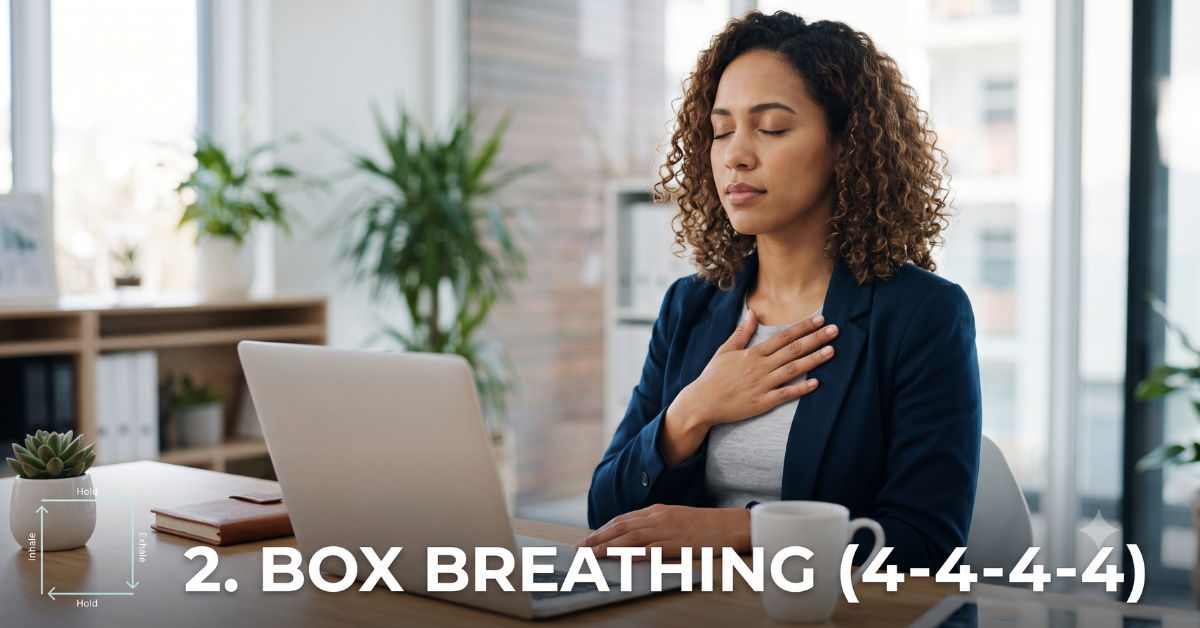
Box breathing earned its reputation with Navy SEALs and combat pilots for a reason: it works under genuine pressure, not just in a quiet room. The pattern is simple — inhale for a count of four, hold for four, exhale for four, hold for four — and repeat.
Why it works: the built-in holds slow your respiratory rate dramatically, which improves carbon dioxide tolerance and reduces the exaggerated “gasping” stress response that shallow, rapid breathing creates. It also gives your prefrontal cortex — the part of your brain responsible for actual decision-making — something structured to focus on, pulling attention away from the spiraling thought loop that’s usually driving the stress in the first place. Counting becomes an anchor when your thoughts are running faster than you can manage.
How to do it at your desk: This one is genuinely invisible to coworkers. Try it right before a high-stakes email send, a difficult call, or a meeting you’re dreading. Four rounds — about a minute — is usually enough to feel your heart rate settle. Many people find it helpful to tap out the count lightly on their leg under the desk, especially the first few times.
Whole-Body Wellness Foundation
Nervous system resilience doesn’t exist in isolation from overall immune and physical health. A comprehensive daily wellness formula can help cover the basics your desk-bound routine tends to miss.
See Wellness Formula →3. The Cold Water Reset
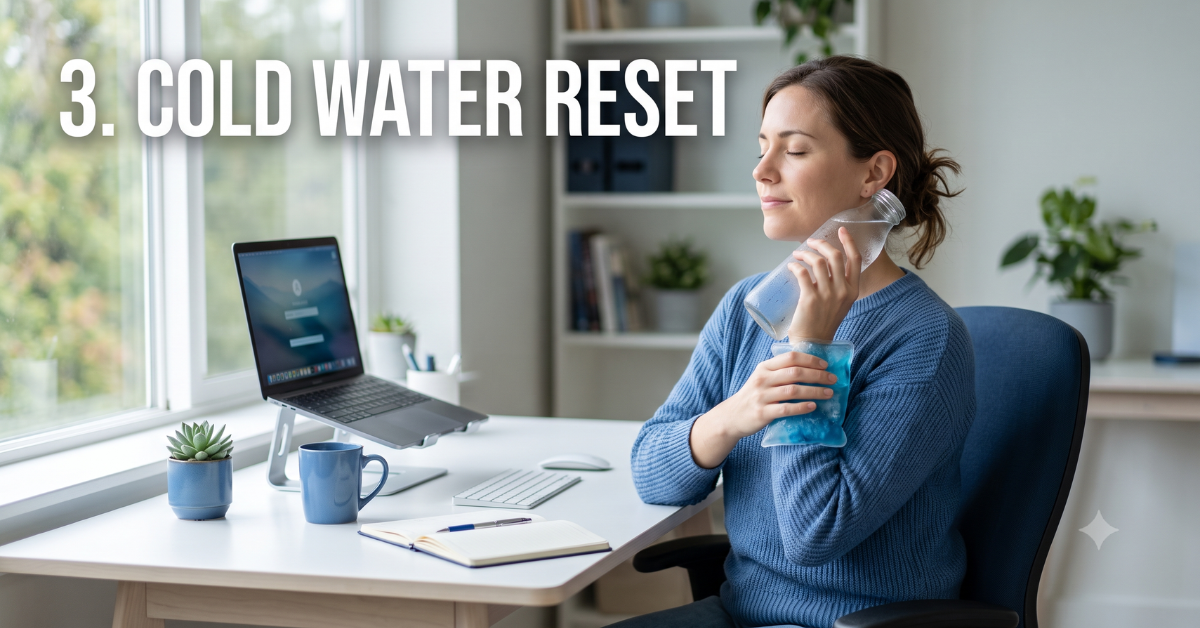
This is the fastest technique on this list, and it works even when your brain feels too fried to remember any breathing pattern at all. It relies on something called the mammalian dive reflex — a hardwired response that slows your heart rate the instant cold touches your face, particularly around the eyes and temples.
Why it works: cold sensation in this region triggers the trigeminal nerve, which has a direct line to the vagus nerve. The result is an almost involuntary drop in heart rate and a fast exit from fight-or-flight — no conscious effort required, which makes it particularly useful in moments when you’re too activated to think clearly. This is the same reflex that makes cold-water swimmers describe an almost immediate sense of clarity after submerging.
How to do it at your desk: Keep a cold water bottle nearby and press it against your wrists, the back of your neck, or briefly against closed eyes. If you can slip away for thirty seconds, splashing cold water on your face in the restroom works even faster. This is the technique to reach for right after a genuinely stressful moment — a tense call, a piece of harsh feedback, a deadline that just moved up — when your heart is still racing and you need results, not process.
4. Humming and the Bhramari Breath
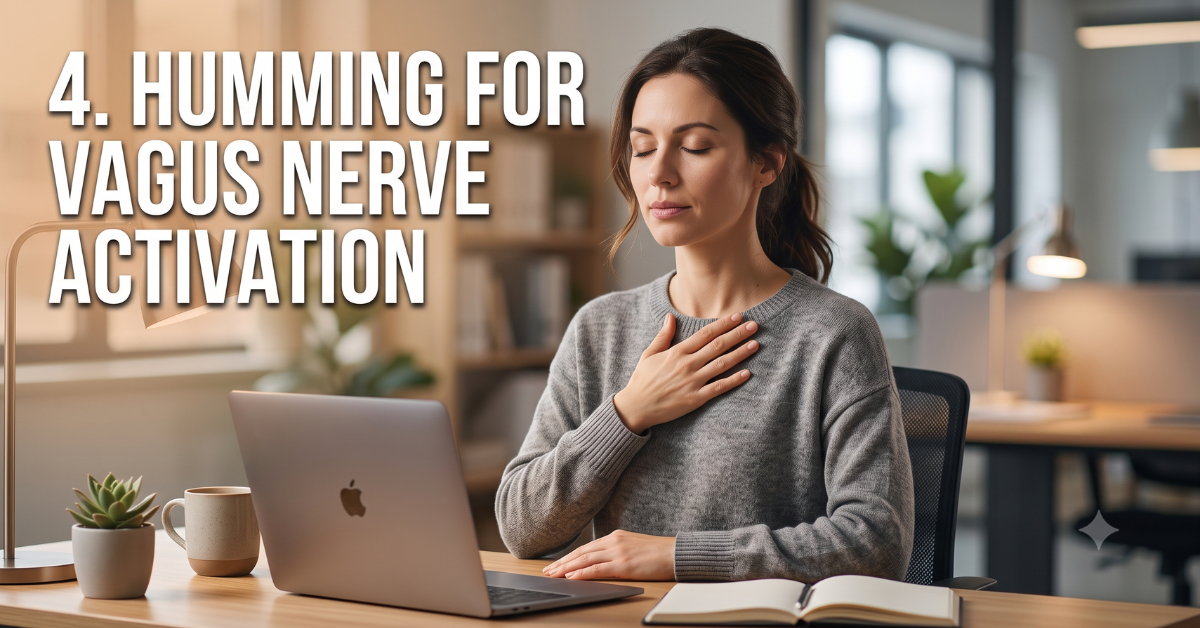
This one sounds almost too simple to be real, but it’s backed by genuine anatomy. The vagus nerve travels extremely close to your vocal cords and inner ear — which means vibration in your throat physically stimulates it.
Why it works: Bhramari, or “humming bee breath,” has been studied for its ability to slow respiratory rate and increase heart rate variability, both markers of parasympathetic activation. Some research has also linked humming and nasal breathing patterns to increased nasal nitric oxide, which supports healthy blood flow and may play a role in the calming response. There’s something almost meditative about the sound itself creating a kind of internal white noise that competes with racing thoughts.
How to do it at your desk: Close your mouth, keep your teeth slightly apart, and hum a low, steady note on the exhale — think less “birthday song,” more low steady buzz. If you share an office, this one is best saved for a moment alone or a call with your camera off. Five to seven slow hums is usually enough to notice a shift, and many people find their exhale naturally lengthens the more they repeat it.
Mind-Body Balance
Many women find that supporting hormonal balance alongside nervous system regulation makes daily stress far more manageable. Shatavari has a long history in Ayurvedic tradition as a calming, balancing botanical.
Learn About Shatavari-Rose →5. Shoulder and Neck Release
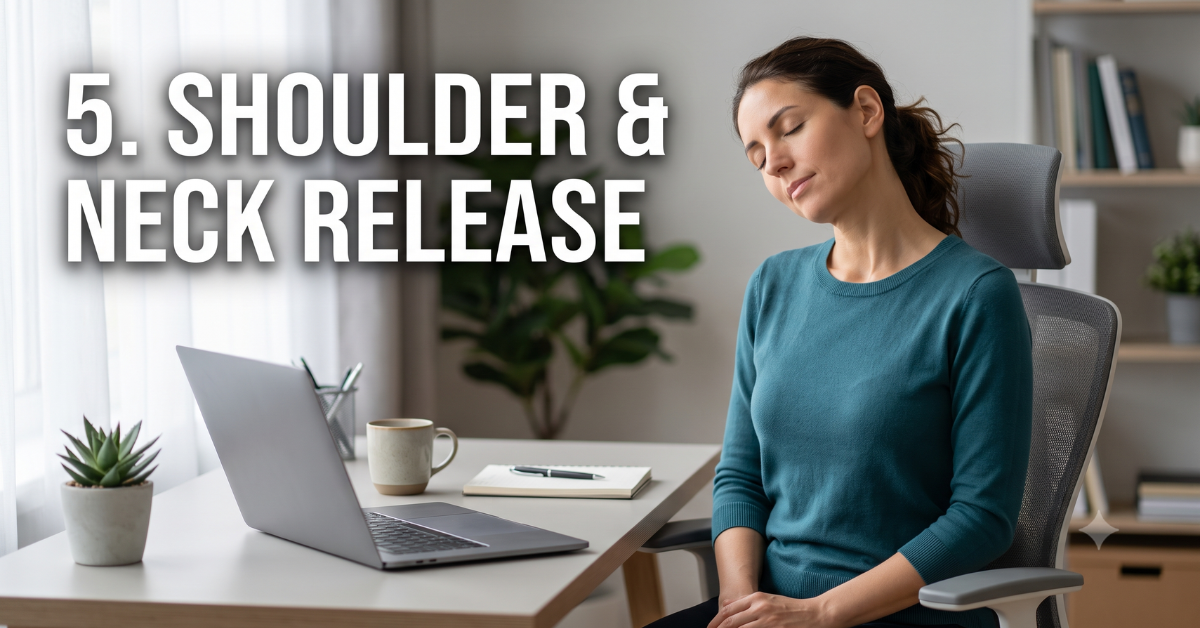
Your brain reads muscle tension as a data point about how safe you currently are. Hunched shoulders, a clenched jaw, and a braced neck are all proprioceptive signals that get fed back to the brainstem — and they can actually keep a stress response running even after the original trigger has passed.
Why it works: deliberately releasing that tension does the reverse — it sends a “the threat has passed” signal upstream. This is the same principle behind progressive muscle relaxation, just condensed into something you can do in your chair without anyone noticing. It’s a two-way conversation between body and brain, and most of us have only ever practiced the tensing half of it, not the release.
How to do it at your desk: Roll your shoulders up toward your ears, hold for two seconds, then let them drop with an exhale. Follow with a slow, gentle neck tilt to each side, holding for a few breaths per side. Unclench your jaw and let your tongue rest away from the roof of your mouth. This entire sequence takes under a minute and pairs especially well with the physiological sigh above — do the release first, then the sigh, and let the exhale carry the tension out.
Quick Reference: Which Technique, When
| Technique | Time Needed | Best Moment to Use It |
|---|---|---|
| Physiological Sigh | 10–20 sec | Right before sending a tense email or joining a call |
| Box Breathing | ~1 min | Before a high-stakes meeting or dreaded conversation |
| Cold Water Reset | 10–30 sec | Immediately after a stressful moment has already happened |
| Humming / Bhramari | ~1 min | Alone, camera off, or during a solo commute |
| Shoulder & Neck Release | ~1 min | Any natural transition point — hourly or between tasks |
Building These Into an Actual Habit
None of these techniques require a wellness retreat or a meditation cushion. What they require is a trigger — something that reminds you to actually use them, because in the moment, a dysregulated nervous system rarely remembers it has options. A simple approach: pick one technique per transition point in your day — before you open your inbox, after a difficult meeting, before you leave for the day — and let that become the cue.
Over weeks, this kind of repeated, brief regulation appears to build something researchers call vagal tone: a nervous system that recovers from stress faster and more completely, even outside of the moments you’re actively practicing. It’s less about eliminating stress at your desk — that’s not realistic — and more about not carrying today’s tension into tomorrow. Think of it less as a single fix and more as strength training for your recovery system: the more often you use it, the faster it responds when you actually need it.
Hormonal Balance Support
Chronic desk stress can quietly affect estrogen metabolism over time. DIM (diindolylmethane) is a compound many turn to for supporting healthy hormone balance alongside lifestyle changes.
View DIM+CDG →When Micro-Resets Aren’t Enough
These five techniques are genuinely effective for acute, in-the-moment regulation — but if you’re finding that stress never fully resolves, even after your workday ends, that’s a signal worth listening to. Chronic nervous system dysregulation sometimes calls for more support than any desk-based technique alone can offer, whether that’s adjusting workload, addressing sleep, or simply giving yourself permission to ask for help.
Extra Resource
Curious about additional stress-support routines beyond what’s covered here? This resource dives deeper into daily practices worth exploring.
Explore More →💡 Frequently Asked Questions
How often should I practice these nervous system regulation techniques?
There’s no strict rule, but many people benefit from using one technique at each major transition point in the day — before checking email, after a stressful meeting, and before leaving work. Consistency matters more than duration; even a single minute, repeated often, tends to outperform one long session.
Which technique works fastest in a genuine panic or stress spike?
The cold water reset tends to act fastest because it relies on a reflex rather than a learned skill — you don’t need to concentrate for it to work. The physiological sigh is a close second and can be done with your eyes open, mid-conversation, if needed.
Can coworkers tell when I’m doing these?
The physiological sigh, box breathing, and shoulder release are all discreet enough to do at your desk without drawing attention. Humming and the cold water reset are better saved for a private moment, such as a solo car ride, an empty conference room, or a trip to the restroom.
Do these techniques replace therapy or medical treatment for anxiety?
No. These are tools for regulating everyday, situational stress responses. If you’re experiencing persistent anxiety, panic attacks, or symptoms that interfere with daily life, it’s worth speaking with a licensed healthcare provider or mental health professional.
Is there real science behind vagus nerve stimulation, or is it just a wellness trend?
The vagus nerve and its role in parasympathetic regulation are well established in physiology and neuroscience. What’s newer is how these findings have been translated into simple, accessible techniques — but the underlying anatomy and mechanisms are not trend-based.
Disclaimer: This article is for informational purposes only and is not a substitute for professional medical or mental health advice, diagnosis, or treatment. Always consult a qualified healthcare provider before starting any new supplement, breathing practice, or wellness routine, particularly if you have an existing health condition.
Your desk doesn’t have to be where your stress lives all day. Small, science-backed resets — practiced consistently — can change how your body carries the workday, one breath at a time.
Stay dewy! 🌿 Bookmark WellbeingPrime.com for more evidence-based wellness guides.
### Recommended Tags
nervous system regulation, vagus nerve stimulation, stress relief at work, breathwork techniques, desk wellness
🌿 Weekly wellness, health & beauty insights — straight to your inbox
Free subscription · Cancel anytime