We walk into a café, drawn by the rich aroma of roasted beans. It starts with just a takeout coffee. But then, there’s that sweet, beautifully glazed pastry sitting behind the glass display, and it feels like the perfect pair. A few blocks down the street, a boutique window catches our eye—a cute dress that would look amazing for the weekend. We step inside, make the purchase, and naturally, decide to splurge on a matching scrunchie to complete the look. By the time the afternoon rolls around, all this shopping has left us exhausted and hungry. We order takeout on the way home and call an Uber because, after a long day, we convince ourselves that we deserve it.
When played on repeat, this sequence of events is no longer just a series of isolated habits; it becomes an entire lifestyle. And it is an incredibly expensive, draining one at that.
Living in California, I’ve seen the modern wellness industry heavily promote the idea that splurging on ourselves—whether it’s a $15 artisanal green juice, a luxury spa retreat, or an impulse online purchase—is the ultimate form of self-care. Society often asks, “What is the point of working so hard if you can’t even treat yourself?” But perhaps we have been conditioned to view fleeting financial splurges as genuine nourishment. Actual self-care looks vastly different. True self-care is about doing the quiet, sometimes unglamorous work to build a life that inherently enriches us from the inside out. When we look closely, those daily little splurges are often just expensive distractions along the way.
Redefining Self-Care: Breaking Free from the “Treat Yourself” Illusion
Growing up in a traditional Korean household, my family lived very frugally. We did not have an abundance of material wealth, but I was as profoundly happy as a child could be. Now, navigating my mid-30s, I have come full circle. I find myself fiercely embracing the very same habits my parents instilled in me decades ago.
These small, everyday decisions—choosing to brew tea at home instead of buying a latte, walking instead of driving—might seem insignificant in the moment. However, the compound effect they have on our mental, physical, and financial well-being is staggering. Living a low-maintenance lifestyle provides a deep, unwavering peace that vastly outweighs any temporary thrill I could possibly buy. I have realized that skipping the coffee shop isn’t a deprivation; it is a conscious choice to protect my peace.
The Psychology of Micro-Spending
Studies in behavioral psychology often refer to the “Diderot Effect,” a phenomenon where obtaining a new possession creates a spiral of consumption, leading you to acquire more things to feel complete. That coffee leads to the pastry; the dress leads to the scrunchie.
To break this cycle, we must redefine what a “treat” actually is. A treat should rejuvenate your spirit, not drain your bank account and leave you with a sugar crash.
Memories Over Material Goods: The True Gift of Experience
I never received physical gifts growing up. Not for my birthday, not for Christmas, and not for any other commercialized holiday. When some people hear this, they immediately assume I had a sad, deprived childhood. The reality is the exact opposite.
My parents understood the holistic value of human connection. Instead of handing us plastic toys that would eventually end up in a landfill, they meticulously crafted experiences for us to remember. For my 10th birthday, there were no expensive gadgets. Instead, we spent the entire day walking down the pier, feeling the ocean breeze, and sharing a simple meal of fish and chips. I still remember the warmth of the sun and the sound of the seagulls to this day.
Why Experiences Outlast Objects
Psychological research consistently shows that experiential purchases bring significantly more joy than material ones. The anticipation of an experience, the joy of the moment, and the nostalgia of the memory create a lasting loop of happiness.
Today, special occasions and holidays feel incredibly exhausting. The focus has shifted entirely away from spending quality time together and moved toward aggressive marketing, limited-edition sales, and the intense pressure to buy things to prove our love.
- The Zero-Gift Rule: My husband and I adopted a zero-gift policy for holidays. We realized that we already have everything we truly need.
- The Wishlist Method: If we genuinely want something, we add it to a shared wishlist and simply buy it for ourselves when the time is right.
- Presence over Presents: On anniversaries or birthdays, we dedicate the entire day to doing our favorite activities together—hiking, cooking, or exploring a new neighborhood.
Removing the pressure of forced consumerism has brought an immense sense of lightness and holistic harmony to our relationship.
The Kitchen as a Sanctuary: Nourishing the Body and Wallet
Thinking back, I only started eating out frequently when I moved to the States. Dining out was framed as the “cool” thing to do to socialize, especially since I worked in the restaurant industry. But during my childhood, my mom was the ultimate caretaker of our nutrition.
She cooked every single meal for us. She packed intricate lunches for my siblings and prepared beautiful bento boxes for my dad. Even when we traveled on family vacations, she would bring a gigantic rice cooker everywhere we went to ensure we had warm, grounding, home-cooked food. As an adult, I appreciate her immense dedication. The sheer time, effort, and love poured into feeding us was an act of pure holistic wellness. And as a natural byproduct, we saved a tremendous amount of money.
The 90/10 Mindful Eating Rule
This year, I made a conscious intention to shift my mindset and return to my roots by cooking more at home. Transitioning away from the convenience of takeout takes creativity, patience, and meticulous planning, but the physical and financial savings are undeniably worth it.
- Financial Impact: If my husband and I go out for a modest dinner, we easily spend around $50 to $70. If we cook at home, even using the absolute highest-quality, organic ingredients, the meal costs less than $20.
- The Strategy: I now abide by the 90/10 rule. I cook at home 90% of the time, treating the kitchen as a sanctuary of nourishment. The remaining 10% of the time is reserved for intentionally trying new restaurants and experiencing different culinary arts without guilt.
Checklist for Mindful Home Cooking:
- Batch Prep Bases: Cook large batches of whole grains (brown rice, quinoa) twice a week.
- Embrace Soups and Stews: Traditional Korean soups are incredibly healing, easy to make in bulk, and perfect for freezing.
- Mindful Grocery Shopping: Shop the perimeter of the store where fresh, whole foods reside. Avoid the highly processed center aisles.

Integrating Wellness Naturally: The Korean Approach to Movement
While I am generalizing, Korean culture is deeply rooted in health-conscious, holistic practices. While modern fitness trends like expensive Pilates classes and boutique weight-training gyms are ubiquitous in cities like Seoul today, the core of Korean wellness is fundamentally different. From a very young age, we are taught to weave healthy habits seamlessly into our daily existence rather than treating fitness as a separate, costly chore.
- Morning Rituals: We wake up and immediately stretch, releasing stagnant energy from the body.
- Herbal Healing: Instead of sugary sodas or energy drinks, we consume copious amounts of warm herbal teas throughout the day to aid digestion and calm the nervous system.
- Nature’s Dessert: We satisfy our sweet cravings with fresh seasonal fruit rather than heavy, processed desserts.
- Community Movement: Korea is filled with breathtaking, accessible mountains. On weekends, it is second nature to gather with friends and family to go hiking.
These habits are ingrained in my DNA. Instead of stressing over expensive gym memberships or purchasing trendy activewear just to feel like I am participating in wellness, I find it infinitely easier—and far more peaceful—to integrate natural movement into my daily life for free. Walking, stretching, and breathing deeply cost absolutely nothing, yet they offer the highest return on our physical health.
Mindful Consumption and the Beauty of Repurposing
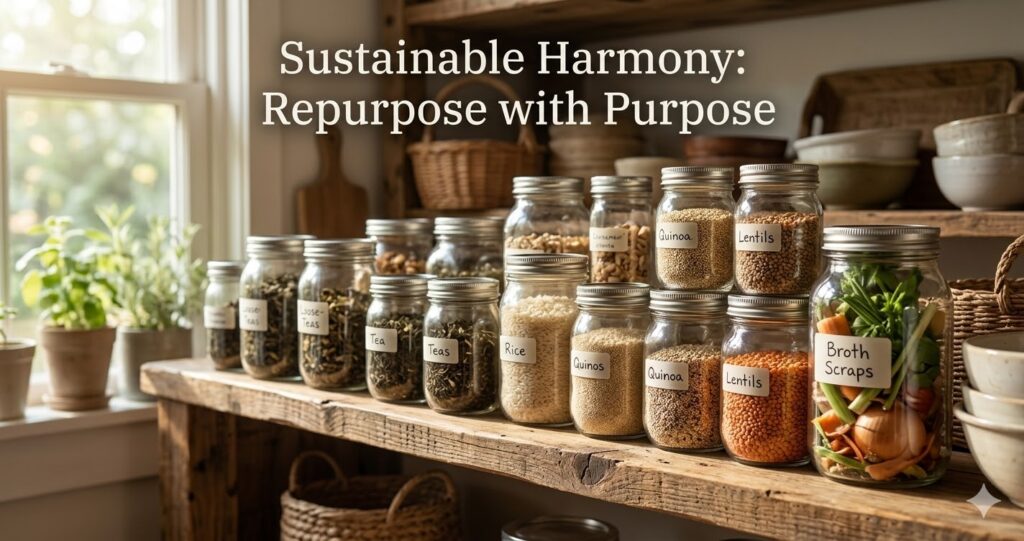
We currently live in the era of the “aesthetic pantry.” Social media feeds are flooded with images of meticulously organized container stores, where every single item is decanted into matching, expensive glass jars. While it is visually pleasing, spending hundreds of dollars on empty containers to hold your groceries is entirely counterintuitive to a low-maintenance, mindful lifestyle.
The secret to a beautifully sustainable home is simple: buy high-quality products that already come in nice glass packaging.
The Art of the Second Life
When you finish a jar of premium tomato sauce or organic jam, do not throw it away. Soak it overnight with a few drops of dish soap, and the label slides right off the next morning. I have a massive collection of repurposed jars that I use to store my bulk loose-leaf teas, grains, and spices. It is infinitely handy and deeply satisfying.
This philosophy of repurposing extends far beyond glass jars. It is about honoring the resources of the earth:
- Save the packaging: Reuse tissue paper and ribbons from original packaging for future gifting.
- Rice Water Magic: Never pour the starchy water from washing rice down the drain. It is packed with nutrients and serves as incredible fertilizer for your indoor plants.
- Art Supplies: Empty yogurt containers make perfect water cups for watercolor painting.
- Zero-Waste Broth: Keep a large container in your freezer for vegetable scraps (onion skins, carrot peels, celery ends). Once full, boil it down to create a mineral-rich, immune-boosting vegetable broth.
Before you throw anything away, pause and ask yourself: “Can I use this for something else?” Over time, this mindful inquiry not only saves an incredible amount of money but drastically reduces your environmental footprint.
Resourcefulness and the DIY Spirit
Everything in our home has a first life and a second life. I am undeniably the person who cuts the toothpaste tube in half to scrape out the last remaining bits, because discarding usable product is simply wasting the energy and money it took to acquire it.
When an item can no longer serve its original purpose, it evolves. An old toothbrush becomes an intricate scrubbing tool for bathroom grout. A worn-out cotton t-shirt is cut up into reusable cleaning rags. A sturdy paper bag becomes a trash liner. Dedicating a single drawer in your home to these resourceful DIY materials does not clutter a minimal space; it empowers it. In many traditional Asian households, throwing away something perfectly usable is viewed as actively losing money and disrespecting the object’s utility.
Reclaiming Our Independence
I am not sure if this is inherently a cultural trait or simply because my husband and I grew up needing to be resourceful, but we strongly prefer to do things ourselves rather than outsourcing our lives to professionals.
I cut my own hair, and I cut my husband’s hair. I groom our dogs. We have taken on our home renovations ourselves, and we even build some of our own furniture. We are incredibly fortunate to live in the Information Age. With platforms like YouTube, we can learn to do practically anything.
For me, taking the time to learn a new skill and doing it with my own two hands is infinitely less stressful than managing contractors or parting with hard-earned money for something I am capable of achieving myself. It fosters a deep sense of self-reliance, groundedness, and holistic capability.
Financial Wellness: The Ultimate Foundation of Peace
Before transitioning to my current career, I worked as a financial counselor. When analyzing people’s finances, I was consistently heartbroken by how many individuals were living their entire lives financed by credit cards.
I understand that leveraging credit can sometimes be a necessary tool to propel you forward in certain stages of life. However, treating credit cards as an extension of your income is a dangerous, slippery slope that leads to chronic stress. The heavy, lingering anxiety of debt creates elevated cortisol levels, directly attacking your holistic health and mental well-being.
The pervasive culture of normalizing credit card debt is not nearly as common in Asia. Growing up, my father drilled into my mind the absolute necessity of paying off debts immediately and living within—or below—my means.
Today, my husband and I use credit cards strictly for the strategic benefits, like accumulating hotel and flight points for our experiential travels, but the balance is always paid in full. Aside from our mortgage—which is essentially equivalent to what we would be paying in rent—we carry zero lingering debt. We absolutely refuse to overspend on things we cannot afford merely to maintain an illusion of status.
Conclusion: The Freedom to Choose
Ultimately, embracing a holistic, low-maintenance lifestyle is not obsessively tracking the few dollars saved by skipping a latte or repurposing a glass jar.
It is about something much grander. It is about cultivating the ultimate freedom. By stepping off the treadmill of constant consumerism and embracing mindful, frugal habits, we eliminate the daily financial anxiety that plagues so many. We build a robust safety net of savings that grants us the power to make meaningful, intentional decisions when the right life opportunities arise.
When you strip away the distractions of the “treat yourself” culture, you are left with a quiet, beautiful, and profoundly peaceful life.
Would you like me to help you brainstorm a weekly home-cooking menu to kickstart this mindful lifestyle?
🌿 Weekly wellness, health & beauty insights — straight to your inbox
Free subscription · Cancel anytime