⚡ Circadian Science · Sleep Optimization · Chronobiology | Updated 2025 | 10 min read
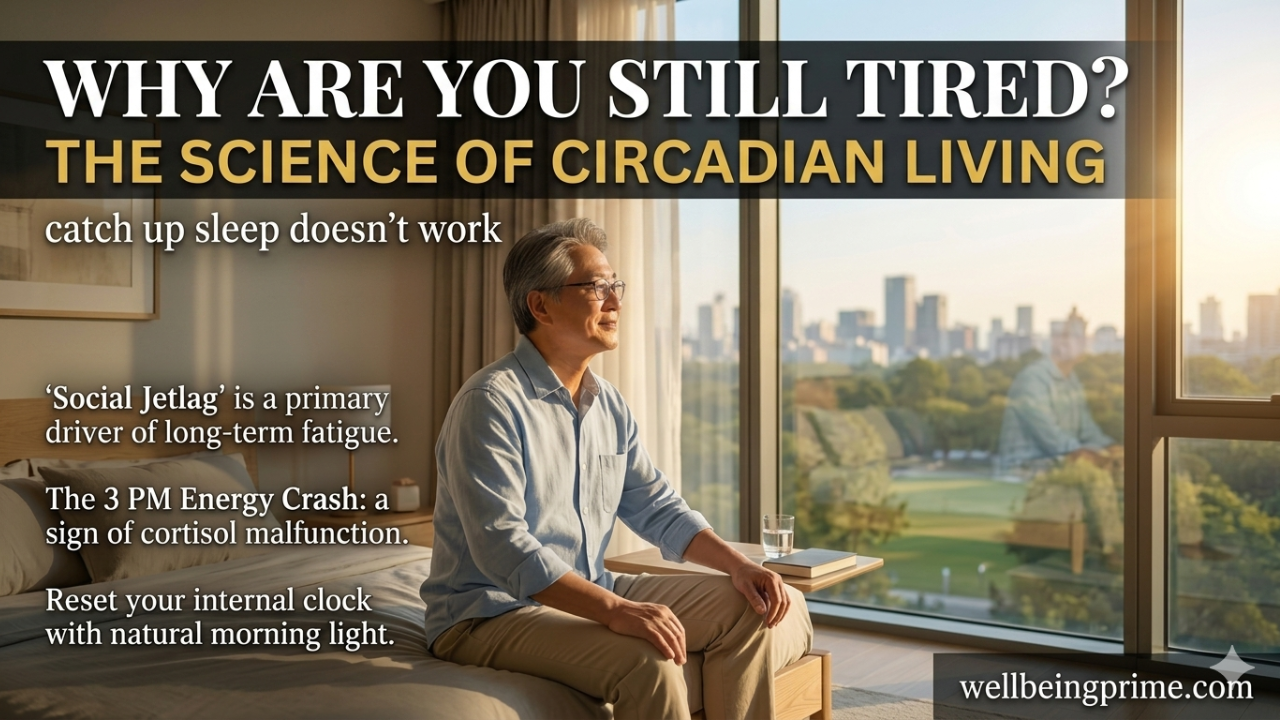
You blocked off the whole weekend. No alarm, no obligations — just pure, uninterrupted sleep. You woke up at noon feeling like you’d been run over by a truck. Sound familiar? If sleeping more still leaves you depleted, the problem isn’t your sleep duration. It’s your circadian rhythm — and it’s quietly running your entire biology from the shadows.
The Hidden Clock That Runs Your Body
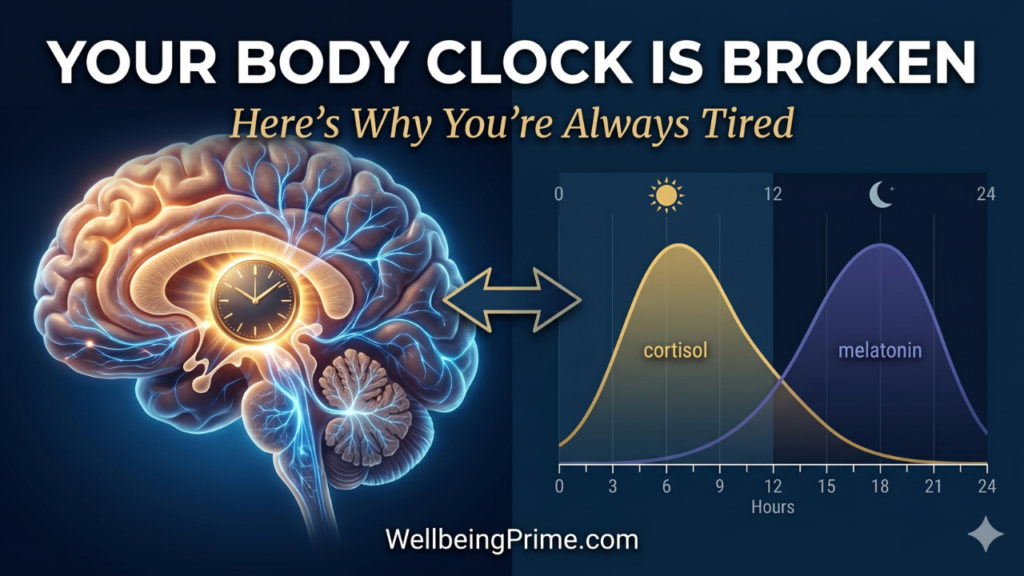
Your circadian rhythm is a roughly 24-hour internal clock embedded in nearly every cell of your body, orchestrated by the suprachiasmatic nucleus (SCN) — a cluster of about 20,000 neurons in the hypothalamus. This biological timekeeper regulates not just sleep and waking, but hormone secretion, immune function, metabolism, mood, and even gene expression.
Think of it this way: your body is less like a single clock and more like an orchestra. The SCN is the conductor. When the conductor is out of step with the musicians — when your master clock and your peripheral organ clocks are desynchronized — the result isn’t harmony. It’s noise. And that noise feels exactly like what you’ve been experiencing: unrefreshing sleep, brain fog, afternoon crashes, and chronic fatigue that no amount of “catching up” can fix.
🔬 Science Note: The 2017 Nobel Prize in Physiology or Medicine was awarded to Jeffrey Hall, Michael Rosbash, and Michael Young for their discovery of the molecular mechanisms controlling circadian rhythms — cementing this field as one of the most significant in modern medicine.
💤 Track your circadian rhythm in real time: Oura Ring Sleep Tracker — the gold standard for sleep and recovery monitoring.
Sleep Duration vs. Sleep Timing: The Crucial Distinction
Modern sleep science has revealed a critical insight that most mainstream sleep advice ignores: when you sleep matters as much as how long you sleep. You can clock 9 hours in bed and still experience profound fatigue if those hours are misaligned with your circadian biology.
This phenomenon is called social jet lag — coined by chronobiologist Till Roenneberg. It describes the chronic mismatch between your social schedule and your body’s natural chronotype. Studies from the University of Munich show that social jet lag affects over 80% of the working population in industrialized nations, and is independently associated with metabolic disease, depression, and cardiovascular risk.
What Is a Chronotype — And Why Does It Matter?
Your chronotype is your genetically influenced preference for sleep timing. Morning larks naturally feel alert at 6 AM. Night owls are biologically primed to be alert past midnight. Neither is wrong. The problem arises when late chronotypes are forced to operate on early-bird schedules — creating a state of perpetual biological time zone conflict that manifests as relentless exhaustion.
3 Signs Your Circadian Rhythm Is Out of Sync
Sign 1 🌙 You Feel Most Alert After 10 PM (and Dead in the Morning)
If your mind suddenly comes alive at 10 PM — creative, sharp, energized — while you’re practically narcoleptic between 7 and 9 AM, your circadian clock is set to a later timezone than your life demands. This is called a delayed sleep phase.
Your body releases melatonin based on darkness cues processed by your SCN. If you’re chronically exposed to bright artificial light in the evening, melatonin release is suppressed and delayed — pushing your entire sleep architecture hours later than optimal. You fall asleep late, wake up early before your biology is ready, and accumulate sleep debt compounded by circadian misalignment — a double-negative combination that no weekend lie-in can resolve.
The fix: Implement “circadian light hygiene.” Dim all lights to below 10 lux after 8 PM. Use blue-light filtering glasses or apps. Anchor your clock with bright outdoor light exposure within the first 30 minutes of waking — this is the most powerful zeitgeber (time cue) available to you.
👓 Block evening blue light effectively: Blue Light Blocking Glasses — clinically shown to increase melatonin levels by up to 58%.
Sign 2 😴 You Wake Up Unrefreshed Even After 8+ Hours
This is perhaps the most frustrating experience: doing everything “right” by the numbers, yet still rising to foggy, heavy exhaustion. The culprit is often sleep architecture disruption — specifically, a collapse in slow-wave sleep (SWS) and REM sleep cycles caused by circadian misalignment.
Your sleep stages follow a circadian-regulated sequence: early-night sleep is dominated by deep, restorative slow-wave sleep; later sleep shifts toward REM. When your sleep timing is misaligned, this architecture collapses. You may get 8 hours, but “out of phase” — experiencing predominantly light sleep (N1/N2) rather than the deep restorative stages that actually leave you feeling human.
Research published in Sleep Medicine Reviews confirms that circadian-misaligned sleep reduces slow-wave activity by up to 20% and suppresses growth hormone secretion. This is why you feel older, stiffer, and more mentally sluggish despite technically sleeping enough.
The fix: Consistency is the master key. Set a fixed wake time — even on weekends — and use it as your circadian anchor. Your entire sleep architecture will reorganize around it within 2–3 weeks.
🛏 Optimize your sleep temperature: Cooling Mattress Pad — keep your body at the ideal 65–68°F sleep zone all night.
Sign 3 ⚡ You Experience a Severe “Post-Lunch Crash” Every Day
A mild dip in alertness after lunch is biologically normal — it corresponds to the post-prandial dip, a circadian trough that occurs roughly 12 hours after your midpoint of sleep. However, if your afternoon crash is debilitating — if you cannot function between 1 and 3 PM without caffeine or a nap — this signals a deeper circadian desynchrony.
Your cortisol awakening response (CAR) — the cortisol surge that should happen within 30 minutes of waking — is blunted. Your adenosine clearance hasn’t been properly managed. And your core body temperature rhythm is irregular.
The fix: Avoid caffeine after 1 PM. If you nap, keep it to 20 minutes before 3 PM. Expose yourself to natural light after lunch — a 10-minute outdoor walk dramatically stabilizes the post-lunch dip.
💊 Support your natural sleep cycle: Melatonin 0.5mg — low-dose melatonin for precise circadian phase support.
The Chronobiology of Light: Your Most Powerful Reset Tool

Light is the most potent zeitgeber in your circadian arsenal. Short-wavelength blue light (approximately 480nm) activates intrinsically photosensitive retinal ganglion cells (ipRGCs) containing the photopigment melanopsin. These cells send direct signals to your SCN, resetting your master clock in real time.
Morning Light: The 30-Minute Rule
Aim for 10–30 minutes of bright outdoor light exposure within the first hour of waking. On a clear day, outdoor light provides 10,000 to 100,000 lux — compared to a typical indoor environment at just 100–500 lux. This single habit is the highest-leverage circadian intervention science currently knows.
☀️ Can’t get outside every morning? Light Therapy Lamp 10,000 Lux — clinically proven to reset your circadian clock in minutes.
Evening Light Management
After sunset, limit light exposure. Research from Harvard Medical School found that even dim room light (8 lux) suppresses melatonin by 50%. Wearing blue-light-blocking glasses after 8 PM has been shown to increase melatonin levels by up to 58% in controlled studies.
Meal Timing and the Peripheral Clock System
Every organ maintains its own peripheral clock, powerfully entrained by meal timing. Eating misaligned with your circadian phase — late-night meals, irregular eating windows — sends conflicting time cues to your liver, gut, and metabolic systems.
Time-Restricted Eating as a Circadian Tool
Research from the Salk Institute led by Dr. Satchin Panda demonstrates that consolidating food intake to a 10–12 hour window aligned with daylight hours significantly improves circadian rhythm strength, sleep quality, and energy levels. Try eating your first meal within 1–2 hours of waking and finishing your last meal 3 hours before bed.
💊 Support deep, restorative sleep naturally: Magnesium Glycinate — the most bioavailable form of magnesium for sleep and muscle recovery.
Exercise, Temperature, and Other Zeitgebers
Exercise Timing
Morning and early afternoon exercise (before 4 PM) reinforces the circadian phase and improves sleep onset. Late-evening vigorous exercise can delay melatonin release by 30–60 minutes.
Temperature: The Overlooked Reset
A warm shower or bath 1–2 hours before bed accelerates the drop in core body temperature, signaling to your SCN that sleep is imminent. Keep your sleeping environment at 65–68°F (18–20°C) for optimal results.
🛏 Maintain the perfect sleep temperature all night: Cooling Mattress Pad — engineered for deep, uninterrupted sleep.
Rebuilding Your Circadian Rhythm: A 7-Day Reset Protocol
Day 1–2: Set a fixed wake time. No snooze. Get outside within 20 minutes of waking. Day 3–4: Begin time-restricted eating — first meal within 2 hours of waking, last meal 3 hours before bed. Day 5–6: Implement strict evening light management. Dim lights, blue-light glasses after 8 PM. Day 7: Maintain consistency through the weekend. Even one “social jet lag” weekend can reset your progress by 2–3 days.
Give this protocol a minimum of 21 days. Most people report significant improvements in morning alertness, afternoon energy stability, and sleep quality within 2–3 weeks.
When to Seek Professional Help
If you’ve implemented consistent sleep hygiene, light management, and meal timing for 3+ weeks with no improvement, consider consulting a sleep specialist. Conditions including Delayed Sleep Phase Disorder (DSPD), sleep apnea, and non-24-hour sleep-wake disorder require clinical diagnosis and may need chronotherapy, light therapy units, or cognitive behavioral therapy for insomnia (CBT-I).
📊 Monitor your sleep stages every night: Oura Ring Sleep Tracker — know exactly what’s happening while you sleep.
For more evidence-based wellness guides, sleep science breakdowns, and longevity tips rooted in real research — bookmark WellbeingPrime.com and never miss a new guide.
Stay dewy! ✨
💡 Frequently Asked Questions (FAQ)
Q1. Can you reset your circadian rhythm in just one night?
No — genuine circadian resynchronization requires consistent behavioral cues repeated over 2–4 weeks. While you may feel slightly better after one night of well-timed sleep, true phase-shifting of the master clock (SCN) requires repeated daily zeitgeber exposures including consistent wake times, morning bright light, and aligned meal timing for a minimum of 14–21 days.
Q2. Does melatonin supplementation fix a disrupted circadian rhythm?
Melatonin is not a sleep drug — it is a phase-shifting signal. Small doses (0.5–1mg) taken at a precise time relative to your circadian phase can advance or delay your clock, but only when used strategically. High doses taken at random times can actually worsen circadian disruption. Always consult a sleep physician before using melatonin for circadian disorders, and prioritize light exposure and behavioral timing as your primary tools.
Q3. What is the fastest way to tell if you have a circadian rhythm disorder?
The clearest diagnostic indicators are: (1) consistently feeling most alert between 10 PM and 2 AM, (2) being unable to fall asleep before midnight regardless of fatigue, (3) extreme difficulty waking at conventional hours, and (4) unrefreshing sleep despite adequate duration. A validated chronotype questionnaire like the Munich Chronotype Questionnaire (MCTQ) can serve as a practical first step, while clinical diagnosis involves actigraphy or DLMO testing by a sleep specialist.
🛍 Complete Sleep Optimization Kit
| Product | Link |
|---|---|
| Blue Light Blocking Glasses | Amazon → |
| Light Therapy Lamp 10,000 Lux | Amazon → |
| Melatonin 0.5mg | Amazon → |
| Magnesium Glycinate Sleep Support | Amazon → |
| Cooling Mattress Pad | Amazon → |
| Oura Ring Sleep Tracker | Amazon → |
🌿 Weekly wellness, health & beauty insights — straight to your inbox
Free subscription · Cancel anytime