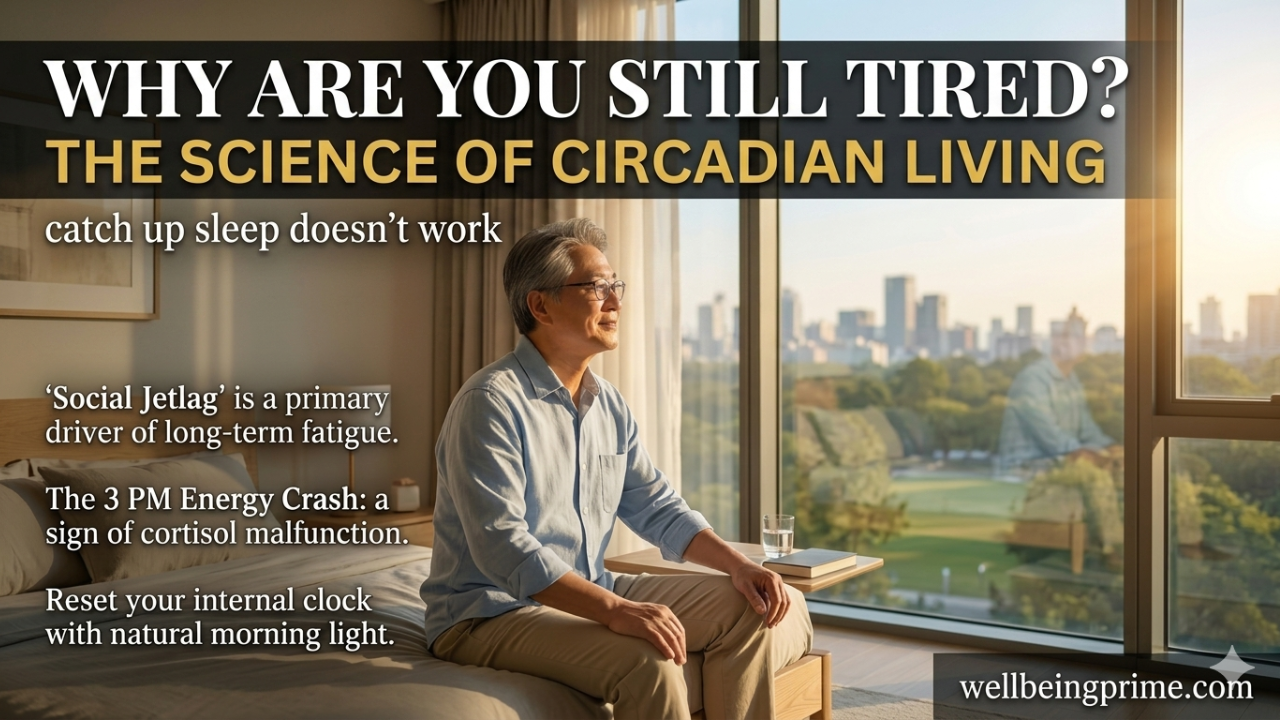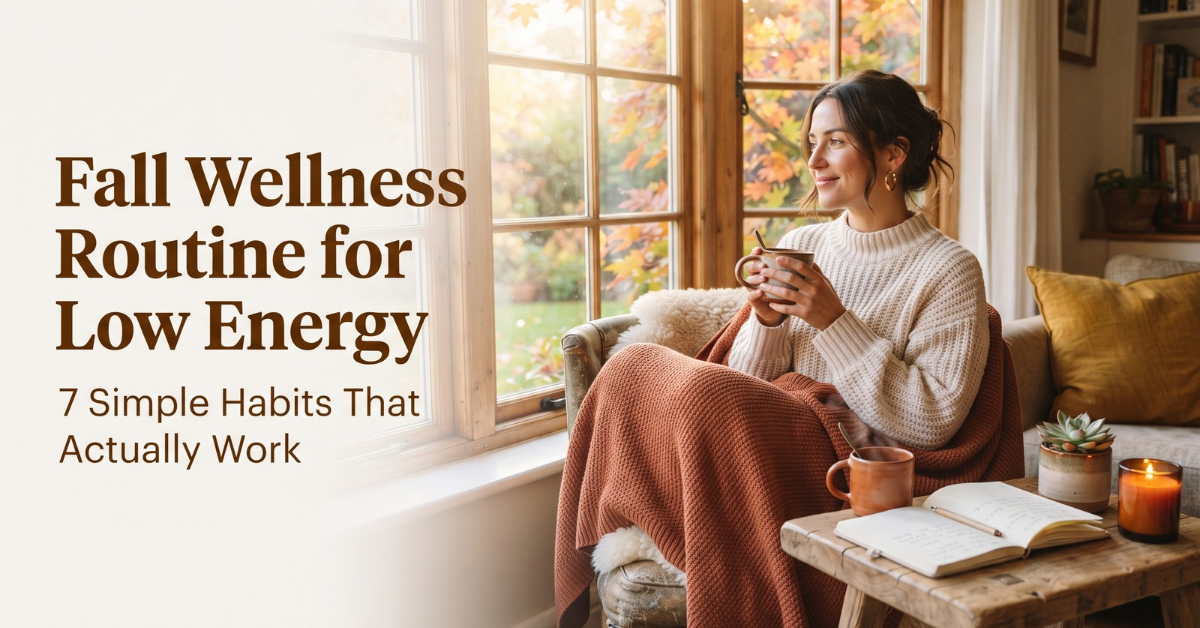
By the WellbeingPrime Editorial Team · Updated October 2026 · 35-minute read

There is a moment every October when the light changes its mind.
You notice it first around four in the afternoon. The sun, which only a few weeks ago lingered over the rooftops like a dinner guest who did not want to leave, now slants low and amber through the kitchen window. The air smells of woodsmoke and wet leaves. Somewhere down the street, a neighbor is raking. A pumpkin sits on a porch step, slightly lopsided, absolutely perfect.
It is beautiful, achingly and cinematically beautiful, and yet you feel like a phone stuck at fourteen percent battery.
You slept eight hours, more or less. You had your coffee, and then you had another one. You even ate something green yesterday. So why does your body feel as though it is wading through warm honey? Why does the 3 p.m. slump now arrive at 1:45 and refuse to leave? Why do the evenings feel strangely wired, and the mornings so heavy that the alarm sounds like a personal insult?
If that sounds familiar, you are in excellent company. Every autumn, millions of people notice the same quiet slide: slower mornings, a mid-afternoon fog that no second latte can lift, a craving for carbohydrates that borders on the poetic, and an evening restlessness that makes falling asleep oddly difficult. Most of us shrug it off as “just the season.” We push harder. We caffeinate more. We promise ourselves we will feel better after the holidays, and then the holidays arrive with their own beautiful, exhausting agenda.
Here is the good news, and it is the thesis of this entire guide: fall fatigue is not a character flaw, and it is rarely random. In large part, it is a predictable biological response to shorter days, cooler temperatures, shifting food patterns, and a calendar that gets fuller just as our daylight gets scarcer. And anything predictable is, to a surprising degree, workable.
This is not a guide about “hacking” your body or chasing the newest optimization gadget. In fact, the most interesting wellness data of 2026 points in the opposite direction. A national survey of 2,000 U.S. adults, conducted by Talker Research for The Vitamin Shoppe’s 2026 Health & Wellness Trend Report, found that among Americans planning to change their routines this year, people were about twice as likely to be simplifying toward baseline habits such as quality sleep, regular movement, and foundational nutrition as they were to be pursuing advanced optimization strategies. The wellness world is, quite literally, coming back to basics.
That is exactly what holistic living has always been about. The word “holistic” comes from the Greek holos, meaning whole. A holistic routine does not treat your energy as a single number to be pumped up with stimulants. It treats energy as an emergent property of the whole system: your light exposure, your gut, your muscles, your nervous system, your sleep, your relationships, and the rhythm of the season you are living in. Pull one lever and the others respond. Pull the right seven levers, gently and consistently, and the whole machine starts to hum again.
Over the next several thousand words, we are going to do three things together. First, we will look under the hood and explain, in plain English, why autumn drains so many of us. Second, we will walk through seven simple habits, each one grounded in research and each one realistic enough to fit into a busy, ordinary, gloriously imperfect life. Third, we will stitch those habits into a single sample day and a four-week plan, so you can stop reading and start feeling the difference.
Think of it as your personal fall holistic wellness routine for low energy, built on science and designed for real life. So pour yourself something warm. Pull the blanket a little closer. Let’s give your body the autumn it has actually been asking for.
Inside This Guide
- Why Fall Leaves You Feeling Drained
- Habit 1: Get Morning Sunlight
- Habit 2: Build a Warm Morning Ritual
- Habit 3: Feed Your Gut for Energy
- Habit 4: Move for 10 Minutes
- Habit 5: Swap the Crash for Herbal Tea
- Habit 6: Take a 5-Minute Calm Reset
- Habit 7: Reset Your Fall Sleep Rhythm
- Your Fall Energy Day and 4-Week Plan
- Frequently Asked Questions
Why Fall Leaves You Feeling Drained (and Why You Need a Fall Holistic Wellness Routine for Low Energy)
Before we fix anything, it helps to understand what we are actually fixing. Autumn fatigue is not one thing. It is a braid of several slow-moving changes that arrive at the same time, each one small enough to ignore and together strong enough to flatten you. Let’s untangle that braid strand by strand.
1. Your Internal Clock Runs on Sunlight
Deep inside your brain, in a region of the hypothalamus called the suprachiasmatic nucleus (SCN), sits a cluster of roughly twenty thousand neurons that acts as your master clock. Think of it as the conductor of an orchestra. Every organ you have, from your liver to your skin, keeps its own local rhythm, but the SCN sets the tempo for all of them.
The conductor’s baton is light. Specialized cells in your retina, called intrinsically photosensitive retinal ganglion cells, contain a light-sensitive pigment called melanopsin that is especially responsive to the bright, blue-rich light of daytime. When morning light hits these cells, they send a signal straight to the SCN that says, in effect, “The day has begun.” That signal helps suppress lingering melatonin, supports a healthy morning rise in cortisol (the hormone that, in the right amount and at the right time, makes you feel alert and ready), and starts a countdown that helps melatonin rise again many hours later, in the evening.
In summer, this system practically runs itself. You are flooded with light from early morning until late evening. In autumn, two things happen at once: the days shorten, and we instinctively move indoors. The result is that the conductor’s signal becomes faint and blurry. A blurry signal means a blurry rhythm, and a blurry rhythm feels like grogginess in the morning, flatness in the afternoon, and a strange second wind at night.
2. The Vitamin D Window Quietly Closes
Your skin makes vitamin D when it is exposed to ultraviolet B (UVB) rays from the sun. But UVB depends heavily on the angle of the sun in the sky. As autumn progresses, the sun sits lower, its rays travel through more atmosphere, and much of the UVB is filtered out before it reaches you. Researchers, including vitamin D pioneer Dr. Michael Holick of Boston University, have long described a “vitamin D winter” at higher latitudes, a stretch of months when the skin makes little or no vitamin D regardless of how long you stand outside. In much of the northern United States, that window begins to narrow in autumn.
Vitamin D is involved in muscle function, immune signaling, and mood regulation, and low levels have been associated in observational research with fatigue. The relationship is not simple, and more is not always better, which is why the smartest move is not to guess. If you consistently feel exhausted, ask your clinician about checking your level. We will return to this in the section on when to see a doctor.
3. The Clock Change Hits Harder Than You Think
In 2026, daylight saving time in the United States ends on Sunday, November 1, when clocks “fall back” one hour. It sounds harmless, even generous: an extra hour of sleep! But your internal clock does not read the kitchen clock. For days afterward, your body is quietly out of sync with your schedule, a mild version of jet lag without the vacation. Evening darkness now arrives before many people have even left work, which pushes even more of our waking hours into artificial light. The American Academy of Sleep Medicine has publicly supported a move to permanent standard time, partly because of how these seasonal shifts disrupt circadian health. Whatever happens with that policy debate, the practical lesson for you is simple: protect your rhythm during the clock change, and you will avoid much of the November slump.
4. Your Gut Feels the Season, Too
Here is something most people never hear: your microbiome, the trillions of bacteria living in your digestive tract, appears to change with the seasons. One of the most striking demonstrations came from a 2017 study published in Science, in which researchers from Stanford and collaborators followed the Hadza, a hunter-gatherer community in Tanzania, and found that their gut bacteria shifted in a cyclical pattern between wet and dry seasons as their diet changed. Most of us do not forage for tubers and honey, but our diets do shift in autumn. Fresh summer produce gives way to heavier comfort food, holiday treats begin to appear, and fiber often drops. Because your gut communicates continuously with your brain through the vagus nerve, immune messengers, and microbial metabolites, those dietary shifts can show up as changes in energy and mood.
5. Comfort Cravings and Blood Sugar Waves
When light drops, many people crave carbohydrates. Some researchers believe this is partly an attempt to boost serotonin-related pathways, a sort of self-medication through pastry. There is nothing wrong with a slice of warm apple pie. The problem is the pattern: a breakfast of refined carbohydrates, a sugary afternoon coffee drink, and a heavy pasta dinner create a series of blood sugar peaks and valleys. Each valley feels like fatigue, irritability, and brain fog, which sends you looking for the next quick hit. It is a loop, and autumn makes it easier to fall into.
6. The Busy-Season Stress Load
Finally, there is the calendar. Fall is the season of fresh starts at school and work, end-of-year deadlines, travel planning, and the long runway into the holidays. Your nervous system does not distinguish neatly between a looming deadline and a looming threat. Chronic, low-grade stress keeps the sympathetic “fight-or-flight” branch slightly switched on, which is metabolically expensive. The classic result is a state many people describe as tired but wired: exhausted all day, oddly alert at bedtime.
Fall Blues or Something More?
For most people, autumn fatigue is mild and responds well to lifestyle changes. For some, it is part of something more significant. Seasonal affective disorder (SAD), first formally described by researchers at the National Institute of Mental Health in the 1980s, is a type of depression that follows a seasonal pattern, most commonly beginning in late fall or early winter. Symptoms can include persistent low mood, loss of interest in activities you usually enjoy, oversleeping, increased appetite and carbohydrate craving, weight gain, and social withdrawal. If your autumn feels less like a dip and more like a fog you cannot see through, please talk with a healthcare professional. SAD is common, it is real, and it is treatable.
Key Takeaway
Fall fatigue is a braid of six strands: weaker light signals, a closing vitamin D window, the clock change, a shifting gut, blood sugar waves, and seasonal stress. The seven habits of this fall holistic wellness routine for low energy are designed to pull on each strand, gently and at the same time.
How to Start Your Fall Holistic Wellness Routine for Low Energy (Without Overwhelm)
A quick but important note before we dive in. You do not need to do all seven habits tomorrow. In fact, please don’t. The fastest way to abandon a wellness routine is to launch it like a moon mission on a Monday and quietly let it crash by Thursday.
Instead, read the whole guide once, notice which habit makes you think, “Oh, that’s the one I’m missing,” and start there. Behavior scientist BJ Fogg of Stanford University, author of Tiny Habits, has shown through years of coaching research that habits stick best when they are small, easy, and anchored to something you already do. Each habit below includes a “smallest possible version” for exactly this reason. Start tiny. Let success build momentum. Then add the next habit.
Think of these seven habits less as rules and more as seasonal instruments. You are the conductor now.
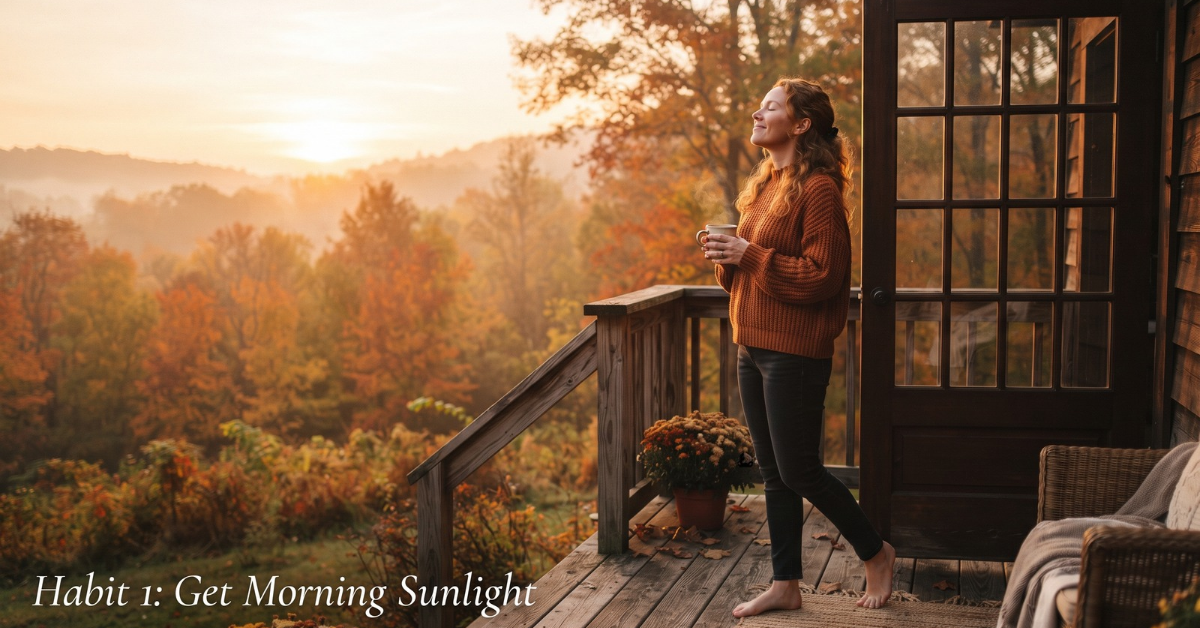
Habit 1: Get Morning Sunlight (Your Free, Ancient Energy Switch)
If you take only one habit from this fall holistic wellness routine for low energy, make it this one. It costs nothing, requires no equipment, takes as little as ten minutes, and works on the deepest layer of your energy system: your circadian rhythm.
Picture your ancestors on an autumn morning. They did not wake up inside insulated boxes lit by a single lamp. They stepped outside to tend fires, gather water, and check on the animals. Their eyes drank in the morning sky every single day, and their internal clocks were set with clockwork precision. Today, many of us can go from bed to car to office without ever spending more than a few seconds in direct daylight. Our biology is still waiting for a signal we no longer send.
The Science: Why Lux Matters More Than You Think
Light intensity is measured in lux. Here is a comparison that surprises nearly everyone. A typical well-lit living room or office often sits somewhere in the range of 100 to 500 lux. A heavily overcast autumn morning outdoors can still deliver well over 1,000 lux, and a clear sunny morning can deliver many tens of thousands. In other words, even a gray October day outside is often many times brighter than your brightest room inside. Your eyes adapt so efficiently that you barely notice the difference, but your circadian system notices everything.
That is why “I sit next to a window” is not quite the same as stepping outside. Window glass reduces light intensity, and you are usually looking at a wall or screen rather than toward the bright sky. Outdoors, with your gaze roughly toward the horizon, the signal to your master clock is dramatically stronger.
The clinical evidence for light is also unusually strong. In a landmark trial published in the American Journal of Psychiatry in 2006, Dr. Raymond Lam and colleagues in the Canadian CAN-SAD study compared bright light therapy with the antidepressant fluoxetine in people with seasonal affective disorder and found the two approaches produced similar improvements. Light therapy has since become a well-established first-line approach for SAD. While a morning walk is not the same as a clinical light box, the underlying mechanism is the same: bright morning light anchors your rhythm, and a well-anchored rhythm supports steadier energy and mood.
The Science, Briefly
Morning light reaches melanopsin-containing cells in your retina, which signal your brain’s master clock. This helps suppress leftover melatonin, supports a healthy morning cortisol rise, and sets the timer for melatonin to return in the evening. Result: brighter mornings and sleepier, easier nights.
How to Do It
- Timing: Aim to get outside within 30 to 60 minutes of waking. Earlier is better, but any morning light beats none.
- Duration: On a bright morning, about 10 minutes may be enough. On a cloudy day, aim for 20 to 30 minutes.
- Direction: Face the general direction of the sky and horizon. Never stare directly at the sun.
- Skip the filter when safe: Regular sunglasses reduce the light signal. If you can comfortably go without them for these few minutes, do. Prescription glasses and contact lenses are fine.
- Combine it: Walk the dog, drink your morning beverage on the porch, stretch on the balcony, or take a phone call outside.
The Smallest Possible Version
Open the front door, step out, and take five slow breaths while looking at the sky. That’s it. Do that every morning for one week, and you will have built the foundation. Most people find that once they are outside, five breaths turns into five minutes on its own.
When It’s Still Dark Outside
As November approaches, many people, especially in northern states, will wake before sunrise. You have two good options. First, turn on bright lights immediately when you wake, then get outside as soon as the sun is up, even if that is during a mid-morning break. Second, consider a light therapy box rated at 10,000 lux, used for about 20 to 30 minutes in the morning at the distance the manufacturer recommends. If you have bipolar disorder, an eye condition, or take medications that increase light sensitivity, speak with your doctor before using a light box.
The Clock-Change Survival Trick
When clocks fall back on November 1, keep your wake-up time and morning light walk anchored to the same new clock time every day that week. Consistency is what helps your internal clock catch up. Of all the moves you can make, a fixed wake time plus morning light is the fastest way to resync.
Key Takeaway
Outdoor morning light, even on a cloudy day, is one of the most powerful and least expensive energy tools you have. Ten to thirty minutes, within an hour of waking, every day.
Habit 2: Build a Warm Morning Ritual (Hydrate First, Then Caffeinate)
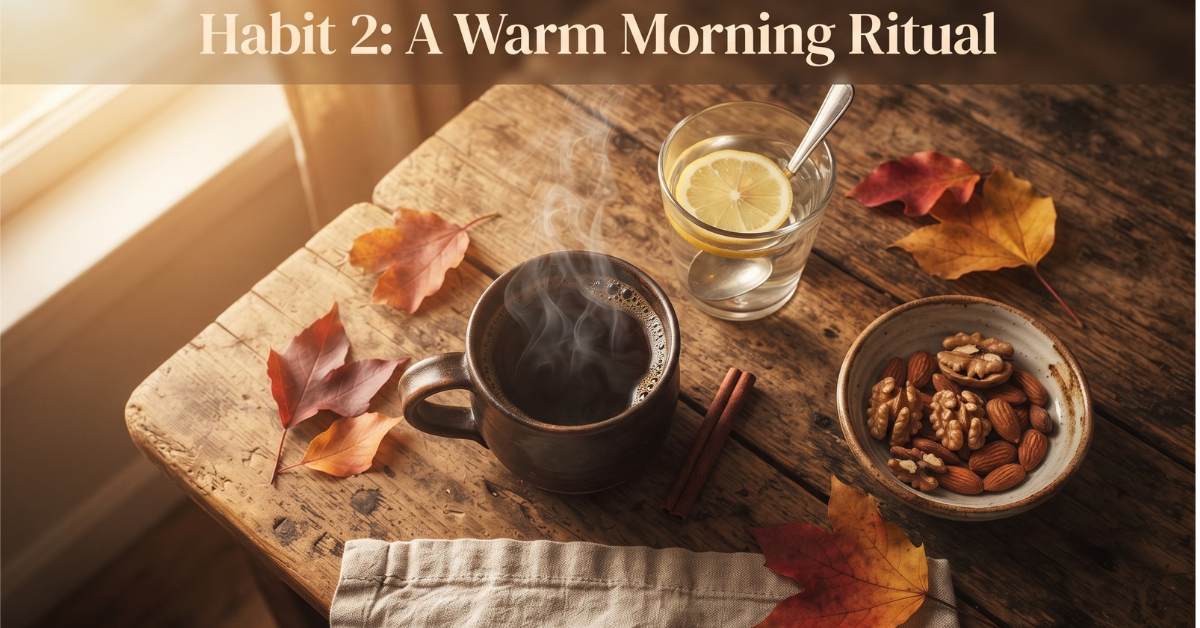
There is a reason the image of a steaming mug on a rainy morning feels so comforting. Warmth is a signal of safety. Ritual is a signal of order. Together, they tell your nervous system that the day is beginning on your terms, not the inbox’s.
But there is a quiet mistake hiding inside most autumn mornings. Many of us wake up already mildly dehydrated after seven or eight hours without water, then reach straight for coffee, then wonder why we feel jittery and drained by ten o’clock. This habit is about reordering the morning so it actually fuels you, and it is the natural second step in any fall holistic wellness routine for low energy.
Step One: Water Before Anything Else
You lose water overnight through breathing and skin, and in cooler months, many people simply drink less because they feel less thirsty. That matters more than it sounds. In a frequently cited 2012 study published in The Journal of Nutrition, Dr. Lawrence Armstrong and colleagues at the University of Connecticut found that mild dehydration, a loss of only around 1.4 percent of body mass, was associated with degraded mood, greater perceived difficulty with tasks, lower concentration, and more headache symptoms in young women. That level of dehydration is easy to reach and hard to notice.
So before your coffee, drink a full glass of water. Make it room temperature or warm if cold water feels unappealing on a chilly morning. A squeeze of lemon is lovely for flavor, and many people find it makes the habit more enjoyable. To be clear, warm lemon water is not a “detox” miracle; your liver and kidneys handle detoxification beautifully on their own. Its power is simpler: it gets water into you, and it turns hydration into a ritual you look forward to.
Step Two: Caffeine, Done Thoughtfully
Caffeine works mainly by blocking adenosine, a molecule that accumulates in your brain during waking hours and creates “sleep pressure.” It is a genuinely useful tool. The problem is not coffee; it is coffee used as a substitute for everything else on this list.
You may have heard the popular advice to delay caffeine for 90 minutes after waking. The idea is intriguing, but the scientific support is still limited and mixed, so we suggest a more relaxed version: drink your water, get your morning light, and have your coffee with or after a little food rather than on an empty stomach. Many people find this simply feels smoother, with fewer jitters and less of a mid-morning crash.
A few more practical guidelines:
- Know your number: The U.S. Food and Drug Administration cites 400 milligrams of caffeine per day, roughly four or five cups of brewed coffee, as an amount not generally associated with negative effects for most healthy adults. Many people feel best well below that. Pregnant people and those with certain health conditions should follow their clinician’s advice.
- Watch the syrup: Seasonal coffee drinks can carry a surprising amount of added sugar, which sets up the blood sugar rollercoaster we described earlier. Try real cinnamon, nutmeg, or a little pure pumpkin puree for the same cozy flavor.
- Set a cut-off time: We will cover this in Habit 5, but for now, plan to make the morning your main caffeine window.
Step Three: A Protein-Forward Breakfast
A breakfast built around protein and fiber, rather than refined carbohydrates alone, tends to produce a gentler, steadier blood sugar curve. Steady blood sugar feels like steady energy. Aim for roughly 20 to 30 grams of protein in the morning if that suits your needs and appetite. Autumn-friendly ideas:
- Steel-cut oats cooked with cinnamon, topped with Greek yogurt, walnuts, and diced apple.
- Two eggs with sautéed spinach and a slice of whole-grain toast.
- A pumpkin-spice smoothie with pumpkin puree, protein powder, chia seeds, and unsweetened almond milk.
- Cottage cheese with roasted pear and a sprinkle of pumpkin seeds.
Why Ritual Itself Matters
Here is the creative, slightly magical part, and it is backed by research too. Studies by Harvard Business School researchers, including work by Alison Wood Brooks and colleagues published in 2016, found that performing a simple ritual before a stressful task reduced anxiety and improved performance. Rituals give the mind a sense of control and predictability. In a season when the light, the weather, and the calendar all feel slightly out of control, a predictable, pleasurable morning ritual becomes a small anchor of calm.
So make it beautiful. Use the mug you love. Light a candle on a dark November morning. Step out onto the porch with your cup while you get your light from Habit 1. You are not just drinking a beverage; you are telling your nervous system a story about the kind of day this is going to be.
Editor’s Pick · Morning Ritual Support
A Dietary Supplement Made for Your Morning Routine
If you like the idea of adding a simple daily supplement to your new morning ritual, this popular dietary supplement is one our readers have been exploring. As with any supplement, read the label carefully and check with your healthcare provider first, especially if you take medication.
Learn More →The Smallest Possible Version
Place a glass next to your coffee maker tonight. Tomorrow, fill it and drink it before you press brew. That single cue, glass before coffee, is the entire habit in seed form.
Key Takeaway
Water first, light second, coffee with food, and a protein-forward breakfast. Wrap it all in a ritual you genuinely enjoy, and your mornings start working for you instead of against you.
Habit 3: Feed Your Gut for Energy (The Autumn Harvest Plate)

Autumn is, quite literally, harvest season. The farmers market is suddenly piled with things that look like they were designed by a nutrition scientist with a flair for color: deep orange squash, burgundy beets, glossy apples, knobby sweet potatoes, emerald Brussels sprouts. Nature hands us a gut-health toolkit exactly when we need it most. Most of us walk right past it on our way to the pumpkin bread.
This habit is about turning that harvest into energy, and in a fall holistic wellness routine for low energy, the route goes straight through your gut.
The Gut-Energy Connection, Explained Simply
Your gut is far more than a food processor. It hosts a large share of your immune tissue, and it contains an extensive network of neurons sometimes called the “second brain,” formally known as the enteric nervous system. It is also home to trillions of microbes that ferment the fiber you cannot digest yourself. When they do, they produce compounds called short-chain fatty acids, including butyrate, acetate, and propionate. Butyrate is a primary fuel for the cells lining your colon and helps maintain a healthy gut barrier. These microbial metabolites also influence inflammation and communicate with the brain through what scientists call the gut-brain axis.
You may have read that about 90 percent of your body’s serotonin is produced in the gut. That is broadly true, but here is the nuance most articles skip: gut serotonin largely does not cross into the brain. Its influence on mood and energy appears to be more indirect, through nerve signaling, immune pathways, and metabolism. The takeaway is not “eat yogurt, get happy.” It is that a well-fed, diverse microbiome is part of the physiological foundation of feeling well.
Low-grade, chronic inflammation is one of the quiet drains on energy. When your immune system stays slightly activated, it can contribute to that heavy, flu-ish, “I just want to lie down” feeling. A fiber-rich, diverse diet is one of the most well-supported ways to support a balanced inflammatory state.
The Fiber Gap (and Why “Fibermaxxing” Is Trending)
The Dietary Guidelines for Americans recommend about 14 grams of fiber for every 1,000 calories, which works out to roughly 25 to 34 grams a day for most adults. Yet the overwhelming majority of Americans fall short; one widely cited analysis estimated that about 95 percent of adults and children do not meet the recommendation. That gap is why nutrition experts have named fiber one of the defining wellness trends of 2026, and why social media has nicknamed the movement “fibermaxxing.”
We love the enthusiasm, with one caution: increase fiber gradually. Jumping from 12 grams to 40 grams overnight is a reliable recipe for bloating and discomfort, which is not exactly an energy boost. Add about 5 grams per week, and drink extra water as you go, since fiber works best when it is well hydrated.
The Fermented Food Discovery
One of the most exciting gut studies of the past several years came from Stanford University. In a 2021 study published in Cell, researchers led by Hannah Wastyk, Justin Sonnenburg, and Christopher Gardner assigned healthy adults to eat either a high-fiber diet or a high-fermented-food diet for ten weeks. The fermented-food group, eating foods like yogurt, kefir, kimchi, sauerkraut, and kombucha, saw an increase in microbiome diversity and a decrease in multiple markers of inflammation, including interleukin-6. The researchers counted 19 inflammatory proteins that decreased.
The practical lesson: a daily serving or two of fermented food is a simple, delicious, research-supported addition to your autumn table. A spoonful of sauerkraut beside your roasted vegetables. A glass of kefir in your morning smoothie. A little kimchi folded into scrambled eggs.
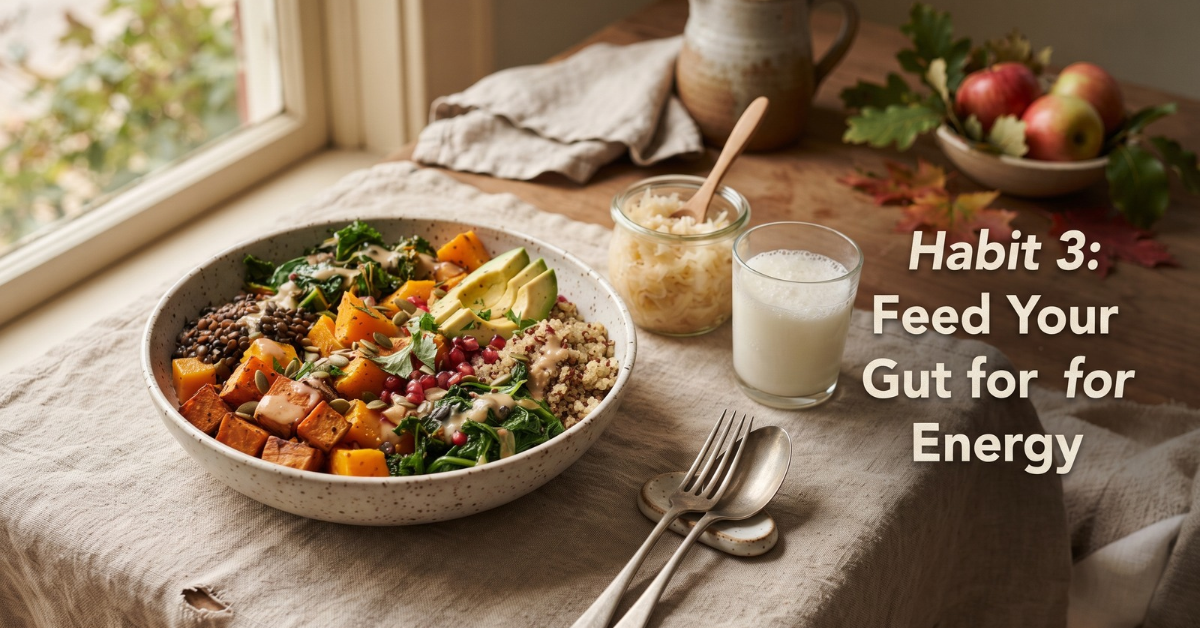
Build Your Autumn Harvest Plate
Forget calorie counting. Use this simple visual template at lunch and dinner:
- Half the plate: colorful plants. Roasted butternut squash, Brussels sprouts, beets, carrots, kale, cauliflower, or a big autumn salad.
- A quarter: protein. Lentils, chickpeas, salmon, chicken, tofu, eggs, or turkey.
- A quarter: slow carbohydrates. Sweet potato, wild rice, farro, quinoa, or whole-grain bread.
- A drizzle of healthy fat. Olive oil, avocado, walnuts, or pumpkin seeds.
- A fermented garnish. Sauerkraut, kimchi, a dollop of yogurt, or a splash of kefir dressing.
That combination of fiber, protein, and fat slows digestion and smooths out blood sugar, so lunch does not turn into a 2 p.m. nap request.
Autumn’s Top Energy Foods
- Apples and pears: rich in pectin, a soluble fiber your gut microbes love. Eat the skin.
- Lentils and beans: fiber, plant protein, and iron in one inexpensive package.
- Sweet potatoes and winter squash: complex carbohydrates plus beta-carotene.
- Pumpkin seeds: a convenient source of magnesium, zinc, and iron.
- Oats: beta-glucan fiber for a slow, steady release of energy.
- Brussels sprouts and cabbage: fiber plus the raw material for homemade sauerkraut.
- Fatty fish like salmon and sardines: omega-3 fats and some of the few food sources of vitamin D.
A Special Note on Iron
Iron deficiency is one of the most common nutritional causes of fatigue, particularly in people who menstruate, pregnant people, frequent blood donors, and those on plant-based diets. Plant iron is absorbed better when paired with vitamin C, so squeeze lemon over your lentil soup or add bell peppers to your bean chili. Because too much iron can also cause problems, do not start high-dose iron supplements without a blood test and guidance from your clinician.
If you want to round out your harvest plate with thoughtfully curated wellness essentials, you can explore our partner shop at gmartus.com, where we gather health products that pair naturally with the routines we write about here.
The Smallest Possible Version
Add one fermented food and one extra serving of an autumn vegetable to just one meal a day. That’s all. In a week, your taste buds will start asking for it.
Key Takeaway
A diverse, fiber-rich, lightly fermented autumn diet feeds the microbes that help regulate inflammation and energy. Build half your plate from harvest vegetables, add fiber slowly, and enjoy something fermented daily.
Habit 4: Move for 10 Minutes (The Energy Paradox)
Here is one of the great paradoxes of the human body: when you feel tired, the thing you least want to do, which is move, is often the thing that will make you feel least tired. It sounds like a riddle. It is actually physiology.
In autumn, the pull toward hibernation is strong. The couch is soft, the evenings are dark, the weather is moody, and streaming platforms release their biggest shows just as the temperature drops. It is the perfect storm for a sedentary season. And a sedentary season tends to feel like a tired one, which is why movement sits at the heart of a fall holistic wellness routine for low energy.
The Study That Changed How We Think About Fatigue
In 2008, researchers at the University of Georgia, led by Tim Puetz and Patrick O’Connor, recruited sedentary young adults who reported persistent fatigue but had no diagnosed medical condition. Over six weeks, participants did either low-intensity or moderate-intensity cycling for 20 minutes, three times a week, while a control group did not exercise. Both exercise groups reported about a 20 percent increase in energy levels. Even more surprising, the low-intensity group reported a larger drop in fatigue, about 65 percent, than the moderate group.
Read that again: gentle movement beat harder movement for reducing fatigue in tired people. That is wonderful news for anyone who feels too drained for a workout. You do not need to crush a spin class. You need to get the engine turning over.
Exercise Snacks: The Trend Backed by Real Data
One of 2026’s favorite wellness phrases is “snack-sized workouts,” and it has solid science behind it. In a 2022 study published in Nature Medicine, Emmanuel Stamatakis and colleagues at the University of Sydney analyzed wearable data from over 25,000 adults who described themselves as non-exercisers. They found that short bursts of vigorous everyday activity, such as briskly climbing stairs or speed-walking to the bus for one to two minutes, about three times a day, were associated with substantially lower risk of mortality. The researchers called it VILPA, short for vigorous intermittent lifestyle physical activity.
The lesson for your autumn: movement does not have to be a separate event that requires a gym bag and a free hour. It can be sprinkled throughout the day like seasoning.
The After-Meal Walk
If you choose only one time to move, choose right after a meal. A 2022 meta-analysis in Sports Medicine by Aidan Buffey and colleagues found that even light walking after eating was associated with lower post-meal blood sugar compared with prolonged sitting. Your muscles act like sponges for glucose when they are working. A ten-minute stroll after lunch can soften the spike and the crash that follows, which is often the real culprit behind afternoon fatigue.
Take It Outside When You Can
Autumn is arguably the most beautiful season to walk outdoors, and nature exposure appears to bring its own benefits. A 2019 study in Scientific Reports led by Mathew White at the University of Exeter, drawing on data from nearly 20,000 people in England, found that people who spent at least 120 minutes a week in nature were significantly more likely to report good health and high well-being than those who spent none. Interestingly, it did not seem to matter whether those minutes came in one long visit or several short ones.
That makes an autumn walk a three-for-one habit: movement for your muscles, daylight for your clock (Habit 1), and nature for your mind. The Japanese practice of shinrin-yoku, or forest bathing, embraces exactly this. Walk slowly. Notice the color of the leaves, the smell of damp earth, the sound your footsteps make. Let the walk be a sensory experience, not just a step count.
Your Weekly Movement Blueprint
The U.S. Centers for Disease Control and Prevention recommends that adults get at least 150 minutes of moderate-intensity activity per week plus muscle-strengthening activity on at least two days. Here is a gentle way to get there in autumn:
- Daily: A 10-minute walk after lunch or dinner.
- Daily: Two or three “exercise snacks”: a brisk stair climb, 20 squats while the kettle boils, or a fast walk to the mailbox.
- Twice a week: 20 to 30 minutes of strength training using body weight, bands, or dumbbells.
- Weekend: One longer nature walk, hike, or leaf-peeping outing with someone you enjoy.
What About Rainy, Dark, or Freezing Days?
This is where most autumn movement plans fall apart. The weather turns, the evenings go dark at 5 p.m., and suddenly the walk feels impossible. The solution is to have an indoor plan ready before you need it. A short, guided at-home routine removes every excuse: no commute, no weather, no gym anxiety. Even 15 minutes in your living room keeps the habit alive until the sun returns.
Editor’s Pick · At-Home Movement
JustFit: Empowering At-Home Fitness Programs
For dark evenings and rainy weekends, JustFit offers guided at-home fitness programs you can follow in your living room, with no equipment or commute required. It’s an easy way to keep your movement habit going all season long, whatever the weather is doing outside.
Explore JustFit →The Smallest Possible Version
After lunch, put on your shoes and walk to the end of the block and back. If you feel like continuing, wonderful. If not, you still showed up, and showing up is the habit.
Key Takeaway
Gentle, frequent movement fights fatigue better than occasional heroic workouts. Walk after meals, sprinkle in exercise snacks, lift something twice a week, and keep an indoor plan ready for bad-weather days.
Habit 5: Swap the Afternoon Crash for an Herbal Tea Ritual
It is 2:47 p.m. The words on your screen have started to swim. Your eyelids feel weighted. Somewhere in your mind, a small voice whispers the most seductive suggestion in modern life: one more coffee.
That afternoon slump is not imaginary, and it is not just about lunch. Sleep scientists describe a natural dip in alertness in the early-to-mid afternoon, often called the post-lunch dip, which is driven partly by your circadian rhythm. It happens even in people who skip lunch. In autumn, when your rhythm is already blurred by shorter days, the dip can feel deeper and arrive earlier.
The problem with answering it with a large dose of caffeine is what happens nine hours later.
The Hidden Cost of the 3 P.M. Coffee
Caffeine has an average half-life of around five hours in healthy adults, though it varies widely from person to person. That means half the caffeine from your 3 p.m. latte may still be circulating at 8 p.m., and a meaningful amount at bedtime. In a well-known 2013 study published in the Journal of Clinical Sleep Medicine, Christopher Drake and colleagues found that a 400-milligram dose of caffeine taken even six hours before bedtime reduced total sleep time by more than one hour. Many participants did not even realize their sleep had been disrupted.
So here is the autumn energy trap in one sentence: afternoon caffeine steals tonight’s sleep, which causes tomorrow’s fatigue, which demands more afternoon caffeine. Habit 5 of this fall holistic wellness routine for low energy breaks that loop.
The Swap: A Warm Afternoon Tea Ritual
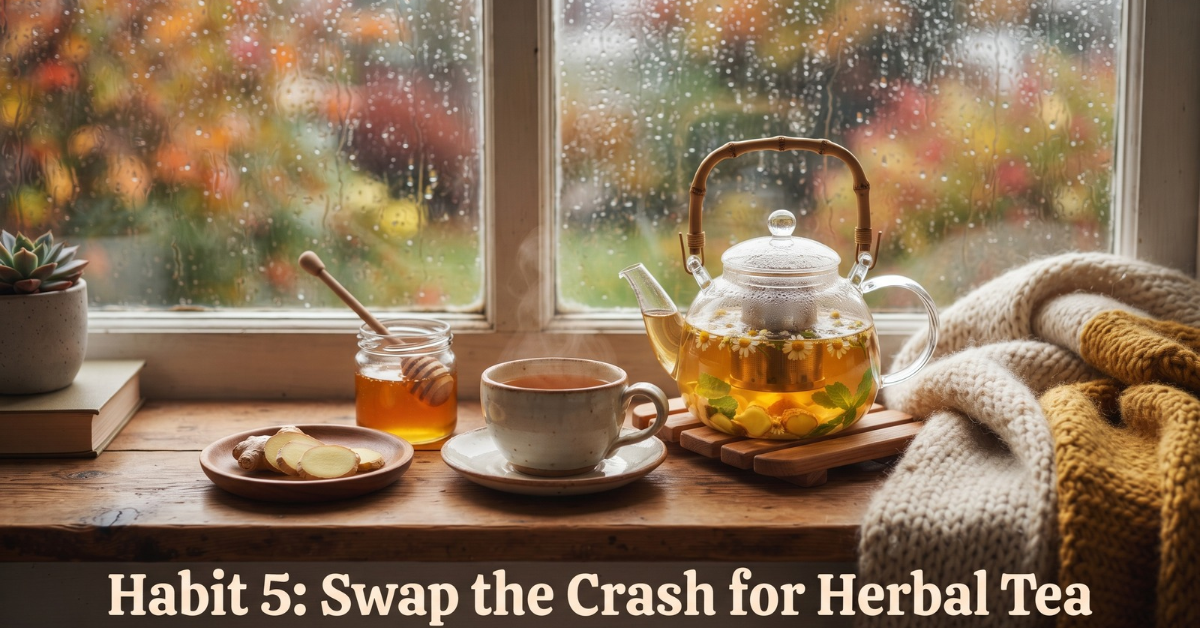
The goal is not to white-knuckle your way through the slump. It is to replace the coffee with something that gives you a gentle lift, warmth, hydration, and a pleasant pause, without sabotaging your night. Tea is perfect for this. Consider these options, roughly from most to least caffeinated:
- Green tea (early afternoon only): Contains far less caffeine than coffee, plus L-theanine, an amino acid. A 2008 study in Nutritional Neuroscience by Gail Owen and colleagues found that the combination of L-theanine and caffeine improved attention-switching and alertness compared with placebo. Many people describe green tea’s energy as calmer and smoother than coffee’s.
- Peppermint tea: Caffeine-free and refreshing. A small study at Northumbria University in the UK found that peppermint tea was associated with improved alertness and memory, while chamomile was more calming. Peppermint is a lovely 3 p.m. choice.
- Ginger tea: Caffeine-free, warming, and traditionally used to support digestion, which makes it especially nice after a heavy autumn lunch.
- Rooibos: Naturally caffeine-free, rich, slightly sweet, and wonderful with a splash of milk and cinnamon.
- Cinnamon and orange peel infusion: Tastes like autumn in a cup, with no caffeine at all.
Make the Ritual Do the Work
Part of what makes the afternoon coffee so appealing is the break itself: standing up, walking to the kitchen, holding something warm, stepping away from the screen. Keep all of that. Just change what is in the mug.
Try this five-minute ritual. Stand up. Fill the kettle. While it heats, stretch your arms overhead and roll your shoulders. Look out a window, ideally toward the sky, which gives your eyes a break from close-up screen focus. Pour the water slowly and watch the color bloom. Hold the warm cup with both hands and take three slow breaths before your first sip. You have just given your body warmth, hydration, light, movement, and a breathing break, all in five minutes.
Set Your Caffeine Cut-Off
Most sleep experts suggest stopping caffeine roughly 8 hours before your intended bedtime, though sensitive people may need even more distance. If you go to bed at 10 p.m., that means your last caffeinated drink lands around 2 p.m. Write it on a sticky note if you have to. After that, it is herbal tea time.
Editor’s Pick · Tea Ritual
All Day Slimming Tea
If you’d like a ready-made blend for your new tea ritual, All Day Slimming Tea is a popular natural tea blend inspired by traditional recipes from Costa Rica’s Nicoya Peninsula. It’s positioned to support digestion, daily energy, and a calmer evening routine. Check the ingredient list for caffeine content and enjoy any caffeinated portion earlier in the day.
See the Tea Blend →The Smallest Possible Version
Buy one box of caffeine-free herbal tea you genuinely like the smell of and keep it at your desk. Tomorrow at your usual coffee time, make tea instead, just once. Notice how you feel at 9 p.m.
Key Takeaway
The afternoon dip is natural. Answer it with warmth, light, movement, and herbal tea instead of late caffeine, and you protect tonight’s sleep, which protects tomorrow’s energy.
Habit 6: Take a 5-Minute Calm Reset (Your Nervous System’s Reboot)
Here is a sentence that might reframe your whole autumn: a lot of what feels like low energy is actually high stress.
Your autonomic nervous system has two main branches. The sympathetic branch is your accelerator: it raises heart rate, sharpens focus, and mobilizes energy for action. The parasympathetic branch, heavily influenced by the vagus nerve, is your brake: it supports digestion, repair, and rest. A healthy system shifts fluidly between the two throughout the day.
But when stress is constant and low-grade, as it so often is in the busy fall season, the accelerator stays lightly pressed all day. That is metabolically expensive. It is like driving with your foot resting on the gas while also riding the brake. You burn fuel without getting anywhere, and by evening you feel spent yet unable to fully relax. Many people experience this as a tense jaw, shallow breathing, racing thoughts at bedtime, and that “tired but wired” feeling we described earlier.
The beautiful thing is that you have a direct, voluntary line into this system: your breath. That is why a five-minute calm reset belongs in every fall holistic wellness routine for low energy.
The Stanford Breathing Study
In a 2023 study published in Cell Reports Medicine, researchers at Stanford, including Melis Yilmaz Balban, David Spiegel, and Andrew Huberman, compared three five-minute daily breathing practices with five minutes of mindfulness meditation over one month. All of the practices helped, but the breathing technique called cyclic sighing, which emphasizes long, slow exhalations, produced the greatest improvement in positive mood and a larger reduction in resting respiratory rate. The benefits built up over the month, suggesting that consistency matters more than intensity.
Five minutes. Once a day. That is a remarkably small investment for a measurable shift in how you feel.
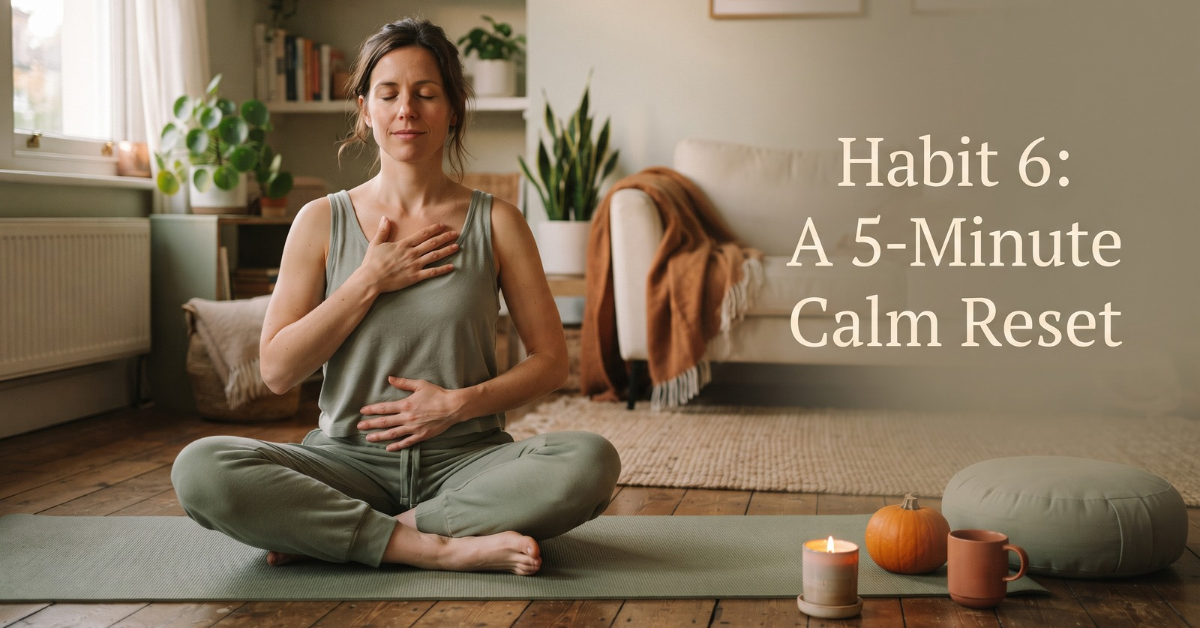
How to Do the Cyclic Sigh
- Sit or lie comfortably. Place one hand on your chest and one on your belly if that feels grounding.
- Inhale slowly through your nose until your lungs feel mostly full.
- Take a second, shorter “top-up” inhale through your nose to fill the lungs completely.
- Exhale slowly and fully through your mouth, letting the exhale be noticeably longer than the two inhales combined.
- Repeat at a relaxed pace for five minutes.
If you feel lightheaded, slow down or return to normal breathing. This should feel soothing, never strained.
Three More Tools for Your Calm Toolkit
- Box breathing: Inhale for 4 counts, hold for 4, exhale for 4, hold for 4. Popular with first responders for steadying focus under pressure.
- Humming exhale: Breathe in through the nose and hum gently on a long exhale. Many people find the vibration soothing, and humming naturally lengthens the out-breath.
- The 5-4-3-2-1 grounding scan: Name five things you see, four you can touch, three you hear, two you smell, and one you taste. It pulls a racing mind back into the present moment.
Lower Your Sensory Load, Especially Sound
Calm is not only about what you do; it is also about what you remove. Modern life is loud. Traffic, open-plan offices, constant notifications, background television, and earbuds turned up to drown out all of the above. The World Health Organization’s environmental noise guidelines have linked chronic noise exposure with stress responses and disturbed sleep. Your ears never fully switch off, even when you are asleep, which means your nervous system is quietly processing sound around the clock.
Give your ears a seasonal rest. Spend part of your evening in genuine quiet. Lower the volume on your headphones and take regular breaks from them. Swap background TV for silence or soft instrumental music. And treat your hearing as part of your holistic health: if you notice ringing, muffled sound, or any change in your hearing, see an audiologist or physician to get it properly evaluated.
Editor’s Pick · Ear Wellness
A New Ear Supplement With Natural Ingredients
Interested in supporting your ear wellness as part of a calmer, quieter routine? This much-talked-about new supplement is formulated with natural ingredients. It is not a substitute for a hearing evaluation, so please see a professional for any hearing changes and check with your doctor before starting any supplement.
Discover the Formula →When to Use Your Calm Reset
There are three especially good moments: right after you get home from work, to signal the transition from “doing” to “being”; after a stressful conversation or email; and about an hour before bed, as the doorway into Habit 7. Pair it with something you already do, such as taking off your shoes when you walk through the door, and it becomes automatic.
The Smallest Possible Version
Do three cyclic sighs right now, before you scroll further. Notice your shoulders. That small drop you just felt is your nervous system saying thank you.
Key Takeaway
Chronic stress quietly drains energy. Five minutes of slow, exhale-focused breathing each day, plus less noise in your environment, helps your nervous system shift out of overdrive.
Habit 7: Reset Your Fall Sleep Rhythm (Where Tomorrow’s Energy Is Made)
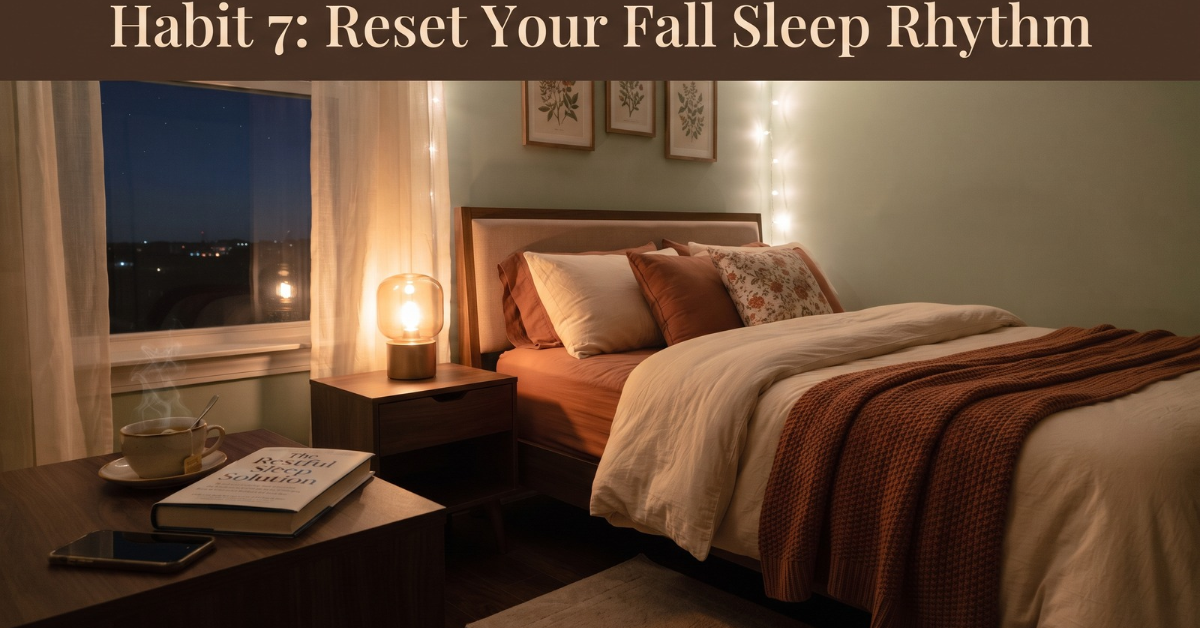
Every habit in this fall holistic wellness routine for low energy eventually flows into this one. Morning light sets the timer for tonight’s melatonin. A thoughtful caffeine cut-off clears the way. Movement builds healthy sleep pressure. A calm reset lowers the nervous system’s volume. Sleep is where all of that pays off, because sleep is where tomorrow’s energy is actually manufactured.
During deep sleep, your body releases growth hormone and supports tissue repair. During REM sleep, your brain processes emotion and consolidates memory. Throughout the night, the brain’s glymphatic system appears to become more active in clearing metabolic byproducts. Skimp on sleep and you do not just feel tired; you start the next day with an unfinished maintenance job.
The U.S. Centers for Disease Control and Prevention estimates that about one in three American adults regularly gets less than the recommended seven or more hours. The American Academy of Sleep Medicine and the Sleep Research Society recommend at least seven hours per night for adults. Autumn, with its clock change and its darker evenings, is the perfect season to rebuild that foundation.
Rule One: Anchor Your Wake Time
If you change only one sleep behavior, make it this: wake up at roughly the same time every day, weekends included, within about an hour. Your circadian rhythm is anchored more by when you wake and see light than by when you go to bed. Sleeping until 10 a.m. on Saturday after waking at 6 a.m. all week creates what researchers call social jet lag, and Monday morning feels like landing after a transatlantic flight. Keep the wake time steady and let bedtime follow naturally.
Rule Two: Navigate the Clock Change Gently
With clocks falling back on November 1, 2026, try this: during the last few days of October, shift your bedtime and wake time about 15 minutes later every day or two. By the time the clocks change, you are already most of the way there. After the change, double down on morning light (Habit 1) to lock in the new schedule.
Rule Three: Design a Cave, Not a Command Center
- Cool: The Sleep Foundation suggests a bedroom temperature of roughly 60 to 67°F (about 15.6 to 19.4°C). Your core body temperature naturally falls as you drift off, and a cool room helps.
- Dark: Use blackout curtains or an eye mask. Cover or remove glowing electronics.
- Quiet: Earplugs or a steady white or brown noise machine can mask disruptive sounds.
- Cozy: Autumn is the perfect excuse for flannel or linen sheets, a weighted or layered blanket, and warm, low lighting.
Rule Four: Dim the Evening
Just as bright morning light tells your brain the day has begun, bright evening light, especially from overhead lights and screens, can tell your brain the day is not over yet. About two hours before bed, switch to lamps with warm-toned bulbs and lower the brightness. Enable night mode on your devices. Better still, put the phone on its charger outside the bedroom and pick up a paper book. Your melatonin rise will thank you.
Rule Five: Try the Warm Bath Trick
Here is a lovely autumn ritual with real science behind it. A 2019 systematic review and meta-analysis in Sleep Medicine Reviews, led by Shahab Haghayegh at the University of Texas at Austin, found that a warm bath or shower of about 104 to 109°F (40 to 43°C), taken one to two hours before bed, was associated with falling asleep faster, on average about ten minutes sooner. The warm water draws blood toward your hands and feet, which then helps your core body temperature drop, mimicking the natural cooling that signals sleep.
Your 60-Minute Wind-Down Ritual
- 60 minutes before bed: Warm bath or shower. Lights down to lamps.
- 45 minutes before: Pajamas, a cup of chamomile or another caffeine-free tea, phone on the charger outside the room.
- 30 minutes before: Five-minute calm reset from Habit 6, then a few minutes of light journaling. Write down tomorrow’s top three tasks so your mind can stop rehearsing them.
- 15 minutes before: Read something calming on paper.
- Lights out: Same time most nights. If you cannot sleep after about 20 minutes, get up, do something quiet in dim light, and return when you feel sleepy.
Editor’s Pick · Evening Calm
MindSilence
MindSilence is a natural wellness supplement created to support calm, mental clarity, restful sleep, and auditory comfort, which makes it a thoughtful companion to your new wind-down ritual. As always, review the ingredients and talk with your healthcare provider before adding it to your routine.
Discover MindSilence →The Smallest Possible Version
Tonight, put your phone on its charger outside your bedroom 30 minutes before you plan to sleep. Set a regular alarm clock if you need one. Just that one boundary often transforms the quality of an evening.
Key Takeaway
Anchor your wake time, ease through the clock change, keep the bedroom cool, dark, and quiet, dim the evening, and give yourself a 60-minute wind-down. Sleep is not the absence of productivity; it is where tomorrow’s energy is made.
Your Fall Holistic Wellness Routine for Low Energy at a Glance
Here is the whole fall holistic wellness routine for low energy on a single screen. Bookmark this table, screenshot it, or print it for the fridge.
| Habit | Time Needed | Why It Works | Easiest Start |
|---|---|---|---|
| 1. Morning Sunlight | 10–30 min | Anchors your circadian clock | Five breaths on the porch |
| 2. Warm Morning Ritual | 10 min | Rehydrates, steadies blood sugar | Glass of water before coffee |
| 3. Gut-Friendly Plate | At meals | Feeds microbes, calms inflammation | One fermented food daily |
| 4. Move 10 Minutes | 10 min+ | Reduces fatigue, smooths glucose | Walk after lunch |
| 5. Herbal Tea Swap | 5 min | Protects tonight’s sleep | Tea instead of 3 p.m. coffee |
| 6. Calm Reset | 5 min | Shifts nervous system toward rest | Three cyclic sighs |
| 7. Sleep Rhythm | 7+ hours | Where energy is rebuilt | Phone out of the bedroom |
A Sample Day: The Fall Holistic Wellness Routine for Low Energy in Action
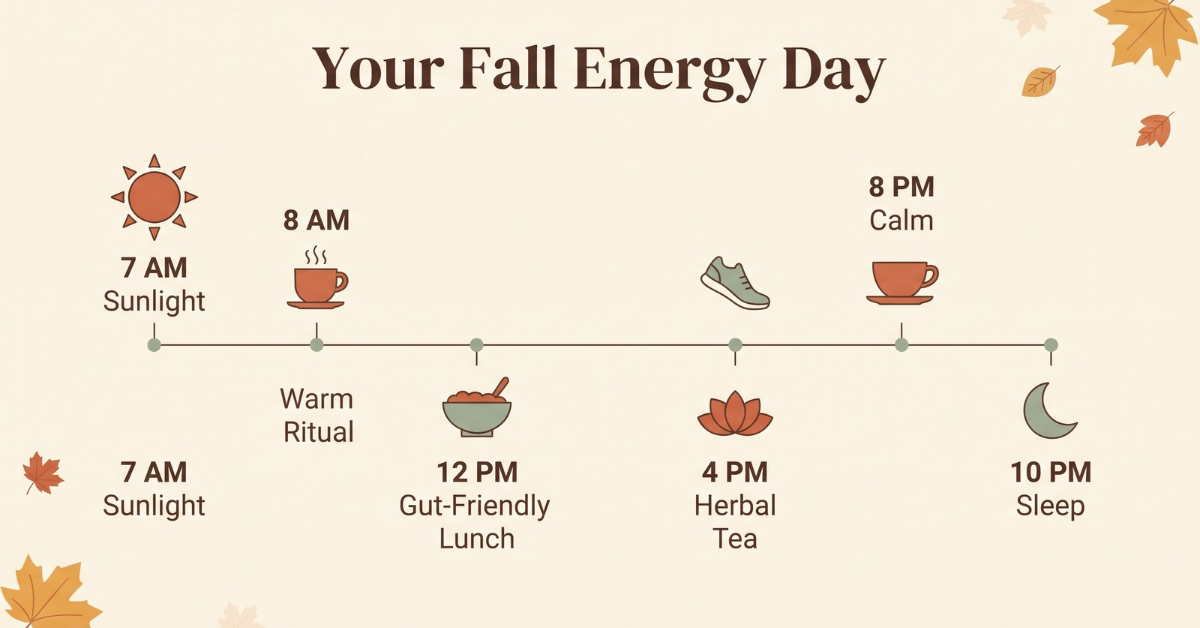
Seven habits can sound like a lot. Laid out across a real day, they turn out to be a handful of small, pleasant moments that fit around the life you already have. Here is what a full Fall Energy Day might look like. Adjust the times to your own schedule; what matters is the sequence.
- 7:00 a.m. | Sunlight. Wake at your anchored time. Drink a glass of water, then step outside for 10 to 20 minutes of morning light. Walk the dog, stretch on the porch, or simply stand and breathe.
- 8:00 a.m. | Warm Ritual. Coffee or tea with a protein-forward breakfast. Light a candle if it is still dark. Enjoy it without your inbox.
- Mid-morning | Exercise Snack. Take the stairs briskly, or do 20 squats between meetings.
- 12:00 p.m. | Gut-Friendly Lunch. Build an Autumn Harvest Plate: half vegetables, a quarter protein, a quarter slow carbs, a fermented garnish. Then take a 10-minute post-lunch stroll if you can.
- 2:00 p.m. | Caffeine Cut-Off. Last caffeinated drink of the day if you sleep around 10 p.m.
- 3:00 p.m. | Walk. Ten minutes outside, ideally somewhere with trees. This doubles as a second dose of daylight before the early sunset.
- 4:00 p.m. | Herbal Tea. Your five-minute tea ritual. Stand, stretch, look at the sky, sip slowly.
- 6:30 p.m. | Light, Early Dinner. Another harvest plate. Try to finish eating two to three hours before bed.
- 8:00 p.m. | Calm Reset. Lights to lamps. Five minutes of cyclic sighing. Quiet replaces background noise.
- 9:00 p.m. | Wind-Down. Warm bath, chamomile, phone outside the bedroom, a paper book.
- 10:00 p.m. | Sleep. Cool, dark, quiet room. Lights out at roughly the same time each night.
The 4-Week Rollout Plan
Remember the rule from the beginning: start tiny, build momentum. Here is a gentle schedule that layers habits week by week, so nothing feels overwhelming.
Week 1: Light and Sleep. Start with Habit 1 (morning sunlight) and Habit 7 (anchored wake time, phone out of the bedroom). These two form the backbone of your circadian rhythm, and almost everything else gets easier once they are in place.
Week 2: Fuel. Add Habit 2 (water before coffee, protein breakfast) and Habit 3 (one fermented food and one extra autumn vegetable daily).
Week 3: Flow. Add Habit 4 (10-minute walk after a meal) and Habit 5 (afternoon herbal tea and a caffeine cut-off).
Week 4: Calm. Add Habit 6 (five-minute calm reset) and complete the full 60-minute wind-down ritual. By the end of the month, you will have built a complete, personalized fall routine.
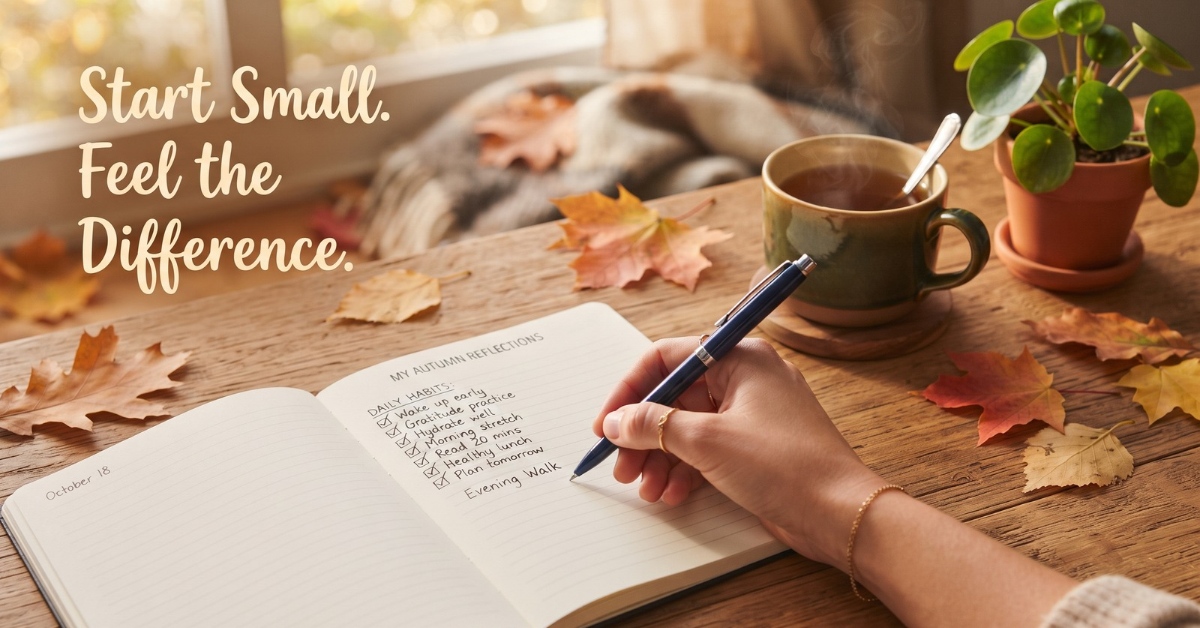
A tip from behavior science: track your energy, not just your habits. Each evening, rate your day’s energy from 1 to 10 in a notebook or notes app. After two or three weeks, the pattern usually becomes obvious, and seeing your own numbers climb is one of the most motivating feelings in the world.
The Beauty Bonus: Energy Shows Up on Your Skin
Here is a delightful side effect of this routine: people often start looking more rested before they even realize they feel more rested. That is not just flattery. In a 2013 study published in the journal SLEEP, Tina Sundelin and colleagues at the Karolinska Institute in Sweden found that people photographed after sleep deprivation were rated by observers as looking more tired, less healthy, and sadder. Separately, research from University Hospitals Cleveland Medical Center, presented by Dr. Elma Baron and colleagues, linked poor sleep quality with signs of reduced skin barrier recovery.
Autumn also brings its own skin challenges. As humidity drops and indoor heating switches on, the skin barrier can lose water more quickly, a process called transepidermal water loss. The result is the tight, flaky, dull feeling many people notice by November. A holistic approach pairs the inside work of this guide, including hydration, sleep, and a nutrient-rich diet, with a few outside adjustments:
- Switch to a gentler, non-stripping cleanser for the cooler months.
- Look for barrier-friendly ingredients such as ceramides, glycerin, hyaluronic acid, and squalane.
- Run a humidifier in the bedroom, which can benefit both skin and sleep comfort.
- Keep using broad-spectrum sunscreen during your morning light walks. UVA rays are present year-round, even on cloudy days.
If you are refreshing your autumn skincare shelf, browse the curated collection at wemmerce.com for cosmetics that pair beautifully with a dewy, well-rested fall glow.
6 Common Fall Energy Mistakes (and What to Do Instead)
Mistake 1: Treating Coffee as the Whole Strategy
Caffeine masks tiredness; it does not create energy. Used as the only tool, it borrows energy from tonight’s sleep. Instead, let coffee be one part of a morning ritual that also includes water, light, and food.
Mistake 2: Going Into Full Hibernation Mode
Skipping movement because you feel tired often deepens the tiredness. Remember the University of Georgia finding: gentle movement reduced fatigue dramatically. Lower the bar instead of skipping it.
Mistake 3: Forgetting to Drink Water Because You’re Not Thirsty
Cooler weather blunts thirst, but your body still needs fluids. Keep a water bottle or a thermos of herbal tea in sight all day as a visual cue.
Mistake 4: Sleeping In on Weekends to “Catch Up”
A big weekend lie-in shifts your clock and creates Monday jet lag. Keep the wake time within an hour, and if you are truly exhausted, take a short early-afternoon nap of 20 minutes or less instead.
Mistake 5: Bright Screens Until Bedtime
Scrolling in bed tells your brain the day is still going and keeps your mind stimulated. Charge the phone outside the bedroom and swap it for a book.
Mistake 6: The All-or-Nothing Mindset
Missing a day is not failure; it is Tuesday. Holistic wellness is a rhythm, not a streak. The goal is to return to your habits more often than you drift from them, and to treat yourself with the same kindness you would offer a good friend.
When Low Energy Needs a Doctor, Not a Routine
Lifestyle habits are powerful, but they are not a substitute for medical care. Fatigue can be a symptom of many treatable conditions, including anemia, thyroid disorders, vitamin D or B12 deficiency, sleep apnea, diabetes, depression, and others. Please see a healthcare professional if:
- Your fatigue lasts more than two to three weeks despite good sleep and healthy habits.
- You experience unexplained weight changes, shortness of breath, chest pain, dizziness, or heavy menstrual bleeding.
- You snore loudly, gasp during sleep, or wake unrefreshed no matter how long you sleep.
- You feel persistently sad, hopeless, or uninterested in things you usually enjoy, especially if it follows a seasonal pattern.
- You are considering supplements and take prescription medications, are pregnant, or have a chronic health condition.
Your clinician can order simple blood tests such as a complete blood count, ferritin, thyroid panel, vitamin D, and B12 to rule out common causes. And if you are ever struggling with thoughts of self-harm, in the United States you can call or text 988 to reach the 988 Suicide & Crisis Lifeline any time of day or night.
Final Thoughts: Why a Fall Holistic Wellness Routine for Low Energy Works
We tend to think of January as the season for fresh starts. But nature has always suggested otherwise. In autumn, trees let go of what they no longer need. They draw their energy inward, down into the roots, preparing quietly for what comes next. There is a lesson there for us, too.
Your fall fatigue is not a sign that something is broken. It is a signal, an invitation to realign with light, with nourishment, with movement, with rest. The seven habits in this guide are not trendy hacks. They are some of the oldest, most human rhythms there are, now confirmed by modern science: step into the morning light, warm yourself with ritual, eat the harvest, move your body, pause with tea, breathe slowly, and sleep deeply.
That is the quiet power of a fall holistic wellness routine for low energy: it works with the season instead of against it. Start with one. Just one. Let it settle in like a favorite sweater. Then add the next. By the time the last leaves fall, you may find that this was not the season you merely survived, but the season you finally felt like yourself again.
If this guide helped you, bookmark WellbeingPrime.com and come back often. We are always adding new evidence-based wellness guides to help you live well, season after season.
Stay dewy! 🍂
💡 Frequently Asked Questions (FAQ)
Q1. Why do I feel so tired in the fall even when I sleep enough?
Shorter days weaken the morning light signal that anchors your circadian rhythm, which can leave you groggy in the morning and alert at night. Lower vitamin D production, the November clock change, heavier comfort food, and seasonal stress can all add to the effect. Morning light, steady meals, movement, and a consistent wake time usually help within a few weeks.
Q2. How long should I spend in morning sunlight to boost energy?
About 10 minutes on a bright morning and 20 to 30 minutes on a cloudy day, ideally within an hour of waking. Face the sky and horizon, but never look directly at the sun. If it is dark when you wake, turn on bright lights and get outside as soon as the sun rises, or ask your doctor about a 10,000-lux light box.
Q3. What is the best tea to replace afternoon coffee?
For a gentle early-afternoon lift, green tea offers less caffeine than coffee plus L-theanine. After your caffeine cut-off, caffeine-free options such as peppermint, ginger, rooibos, or a cinnamon and orange peel infusion work well. Peppermint tends to feel refreshing, while chamomile is better saved for the evening.
Q4. Which fall foods help with low energy?
Fiber-rich harvest foods such as lentils, beans, oats, apples, pears, sweet potatoes, winter squash, and Brussels sprouts support steady blood sugar and a healthy gut. Pumpkin seeds add magnesium and iron, fatty fish adds omega-3s and vitamin D, and fermented foods like yogurt, kefir, kimchi, and sauerkraut support microbiome diversity. Increase fiber gradually to avoid bloating.
Q5. Are there side effects to increasing fiber or using wellness supplements?
Adding fiber too quickly can cause gas, bloating, and cramping, so add roughly 5 grams per week and drink more water. Supplements can interact with medications or be unsuitable during pregnancy or with certain health conditions, and they are not evaluated by the FDA to treat or cure disease. Always read labels and check with your healthcare provider before starting one.
Q6. How do I adjust my sleep for the daylight saving time change?
Clocks fall back on November 1, 2026. In the days before, shift your bedtime and wake time about 15 minutes later every day or two. Afterward, keep your wake time consistent with the new clock and get bright morning light every day that week to help your internal clock resync quickly.
Q7. How long does it take for a fall holistic wellness routine for low energy to work?
Many people notice better mornings within one to two weeks of consistent morning light and a steady wake time. Benefits from movement, breathing practice, and dietary changes tend to build over three to six weeks. If fatigue persists beyond two to three weeks despite good habits, see a healthcare professional to rule out medical causes.
Health & Beauty Disclaimer: The content on WellbeingPrime.com is for informational and educational purposes only and is not intended as medical advice, diagnosis, or treatment. Always seek the advice of your physician or another qualified health provider with any questions about a medical condition, before starting a new supplement, diet, or exercise program, or before changing your skincare routine if you have a skin condition. Never disregard professional medical advice or delay seeking it because of something you read here.
Statements about dietary supplements have not been evaluated by the Food and Drug Administration. These products are not intended to diagnose, treat, cure, or prevent any disease. Individual results may vary.
Affiliate Disclosure: This article contains affiliate links. WellbeingPrime may earn a commission from qualifying purchases at no additional cost to you.
🌿 Weekly wellness, health & beauty insights — straight to your inbox
Free subscription · Cancel anytime