Stepping into an Olive Young in Seoul at eight in the morning is akin to entering a meticulously curated candy land for skincare enthusiasts. The fluorescent lights gleam off hundreds of innovative formulations, the shelves are meticulously stocked, and the sheer volume of beauty technology on display is nothing short of overwhelming. However, if you observe the aisles closely, a fascinating sociological divide begins to emerge: the stark contrast between the viral products global tourists eagerly pile into their baskets and the deeply trusted staples local Korean women quietly repurchase for their daily routines.
Living in California, where the harsh, relentless sun meets notoriously dry winds, I’ve had to completely rethink my approach to barrier protection and UV defense. The western approach often favors aggressive actives and thick, occlusive layers that can feel heavy in the heat. In contrast, the Korean philosophy centers on lightweight, repetitive hydration, gentle barrier fortification, and formulations so elegant they seamlessly meld with makeup. While there is absolutely nothing wrong with the globally viral products—they are often exceptional in their own right—diving into the local insights reveals a totally different approach to holistic skin health. Let us dissect the ultimate K-Beauty shopping list, exploring the chemical differences, the sensory experiences, and the dermatological reasoning behind these divergent shopping habits.
The Sunscreen Divide: Global Virality vs. Local Textural Elegance
If there is one category where Korean beauty undeniably dominates the global market, it is sun protection. The chemical filters used in K-Beauty are decades ahead of those available in western drugstores, allowing for zero white cast, profound hydration, and elegant finishes.
The Tourist Picks: Proven Global Phenomena
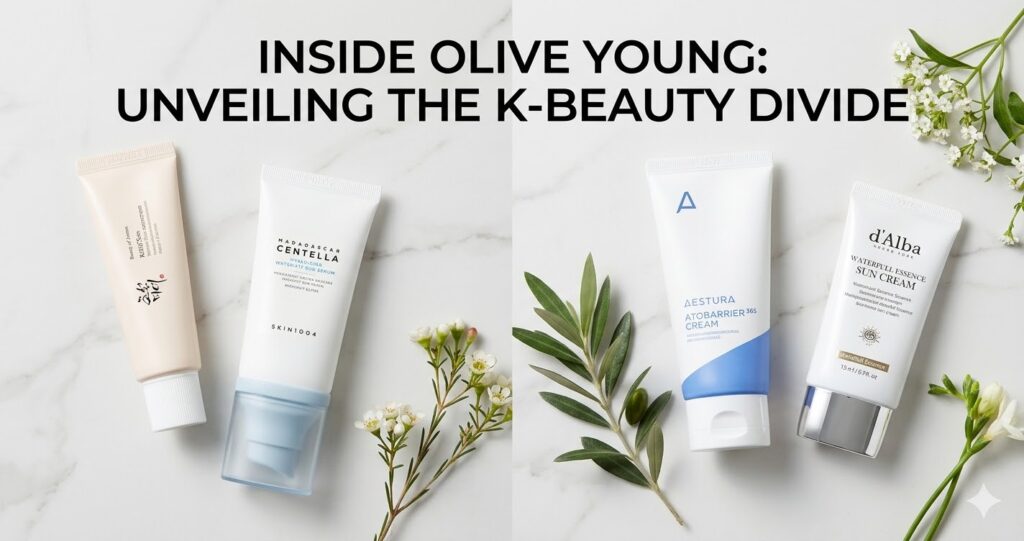
When tourists walk into Olive Young, they typically head straight for the products labeled with “Global Rising Temps”—indicators of massive international popularity. The undisputed champion here is the Beauty of Joseon (BOJ) Relief Sun, alongside the Skin1004 Madagascar Centella Hyalu-Cica Water-Fit Sun Serum. These are phenomenally formulated chemical SPFs. They are beloved for their soothing properties and absolute transparency on all skin tones. If these are in your basket, you have made a phenomenal choice. However, locals often rotate through a different set of hyper-specific formulations tailored to the precise demands of a full makeup routine.
The Local Secrets: Priming, Toning, and Bougie Finishes
What do Korean women actually buy? The local preference heavily leans toward sunscreens that double as flawless makeup primers or subtle tone-up creams.
1. d’Alba Waterfull Essence Sun Cream While d’Alba is globally renowned for their double-layer white truffle mist, their Essence Waterfull SPF is an absolute staple among Korean beauty influencers and locals alike. It possesses a slightly “bougie” textural superiority. Upon application, you might notice a fleeting scent of alcohol—which quickly evaporates—leaving behind an incredibly healthy, luminescent sheen. It does not just protect; it imparts a wealthy, hydrated glow that acts as the perfect canvas for foundation.
2. The Rise of “Tone-Up” Sunscreens In Korea, tone-up creams are a monumental category. Because many Asian skin types feature a yellowish undertone, locals heavily utilize purple or peach-tinted SPF formulations to seamlessly cancel out sallowness and brighten the overall complexion. Instead of relying solely on heavy foundations, Korean women use these tinted sunscreens to achieve that coveted, naturally radiant “glass skin” look with minimal coverage.
3. Round Lab Birch Juice Moisturizing Sun Cream If there is one product that perfectly bridges the gap between tourist hype and local devotion, it is Round Lab. This is the national classic. Everyone—from teenagers to grandmothers to male professionals—uses the Birch Juice sunscreen. It is deeply hydrating, effortlessly absorbed, and frequently available in incredibly lucrative “1+1” (buy one, get one free) promotional sets.
4. pui Vegan EGF Cica Water Sun Ampoule This is a closely guarded local secret. The eternal struggle with sunscreen is that, eight times out of ten, even the most luxurious formulations can cause your foundation to pill or clot. The pui Water Sun Ampoule features a deeply watery consistency, significantly runnier than traditional creams. It absorbs instantly, delivering Epidermal Growth Factors (EGF) and soothing Cica, making it the absolute superior choice for layering underneath heavy makeup without compromising the structural integrity of your base.
5. Laneige Water Bank UV Barrier Sunscreen Word of mouth in Seoul is currently dominated by this specific Laneige SPF. Many chemical sunscreens share a similar, slightly viscous baseline texture. The Water Bank UV Barrier, however, literally feels like splashing fresh water onto your face. It disappears instantly, leaving behind absolute zero tackiness—a rare feat that makes it highly addictive to apply and reapply throughout the day.
Toner Pads: From Harsh Exfoliation to Morning Masks
The way Korean women utilize toner pads is fundamentally different from the western approach. While tourists often view pads as a final cleansing step or a harsh exfoliation tool, locals treat them as rapid, targeted sheet masks. In the morning rush before work, a local will plop two thickly soaked pads on her cheeks for five minutes to rapidly lower the skin’s temperature and inject hydration before applying makeup.
The Danger of Over-Exfoliation
Tourists flock to products like the Medicube Zero Pore Pad. While highly effective for exceptionally thick, oily skin types requiring intense dead skin cell removal, daily use of aggressive AHA/BHA pads can spell disaster. Over-exfoliating strips the acid mantle, leading to transepidermal water loss, micro-tears, and a severely damaged skin barrier. If you use these, do so in moderation, perhaps limiting them to rougher areas like elbows rather than delicate facial skin.
The “Duvet” Approach to Soothing Hydration
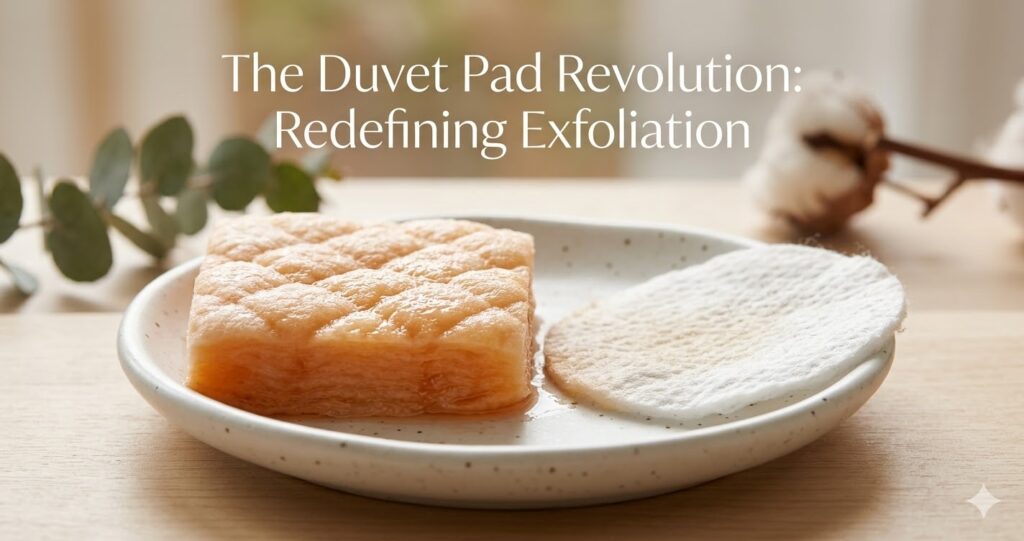
Instead of stripping the skin, locals focus on aggressive soothing. The undisputed champion is the Skinfood Carrot Carotene Calming Water Pad. The pads themselves are uniquely constructed—they are so thick and plush that locals affectionately refer to them as “Ipedu,” translating to “duvet” or blanket toner pads. They feel incredibly gentle and are drenched in an absurd amount of essence.
Similarly, while tourists love the Mediheal Madecassoside pads, locals often prefer the Mediheal PDRN Lifting Pad. The material is tangibly softer, the essence is richer, and the formulation feels significantly safer and more nurturing for compromised barriers.
Sheet Masks: The Hydrogel Evolution
Interestingly, the sheet mask category is one of the rare areas where domestic and international tastes perfectly align. The fundamental shift in K-Beauty right now is the transition from traditional paper masks to advanced hydrogel technology.
The Biodance Phenomenon
The Biodance Hydrogel masks have taken both the global internet and domestic Korean markets by storm. Unlike paper or cotton masks that can dry out and reverse-absorb moisture from your skin if left on too long, hydrogel masks deeply infuse hydration over several hours. They are particularly brilliant for those suffering from contact dermatitis or highly reactive skin, as the smooth gel material causes absolutely zero physical friction.
The Gummy Fit: Abib’s Unrivaled Adhesion
For a more traditional feel with superior execution, locals consistently turn to Abib Gummy Sheet Masks. The term “gummy” refers to the microfiber material’s ability to perfectly clasp and mold to the exact contours of the face, creating a vacuum-like seal. This forces the highly concentrated, luxurious essence deeply into the epidermis. At a price point of often less than a dollar during major sales, it provides a pampering experience that feels exponentially more expensive.
Insider Tip: If you are planning a trip to Korea, time your Olive Young hauls around the months that are multiples of three. The most massive, store-wide sales occur in March, June, September, and November.
Barrier Care: The Foundation of Glass Skin
In western skincare, we often chase active ingredients—Retinol, Vitamin C, strong acids—to force the skin into submission. In Korea, the absolute foundation of beauty is a perfectly intact, deeply fortified skin barrier. Without a healthy barrier, active ingredients will only cause inflammation and accelerated aging.
Lightweight Soothing for the Summer
For global consumers, the Dr. Althea 345 Relief Cream has become immensely popular. It features a beautiful, lightweight gel texture that is phenomenal for combination to oily skin types, or for use during humid summer months. Its nomenclature highlights its core philosophy: three ingredients for blemish care, four for nourishing, and five for soothing (including powerhouses like Panthenol, Ceramide, and Centella Asiatica). While perhaps less famous domestically, it is a masterclass in elegant, lightweight formulation.
Dermatological Repair for Damaged Barriers
When a local Korean woman gets a laser treatment at the dermatologist—a very common monthly routine—she does not reach for lightweight gels. She reaches for heavy-duty, clinically backed barrier repair.
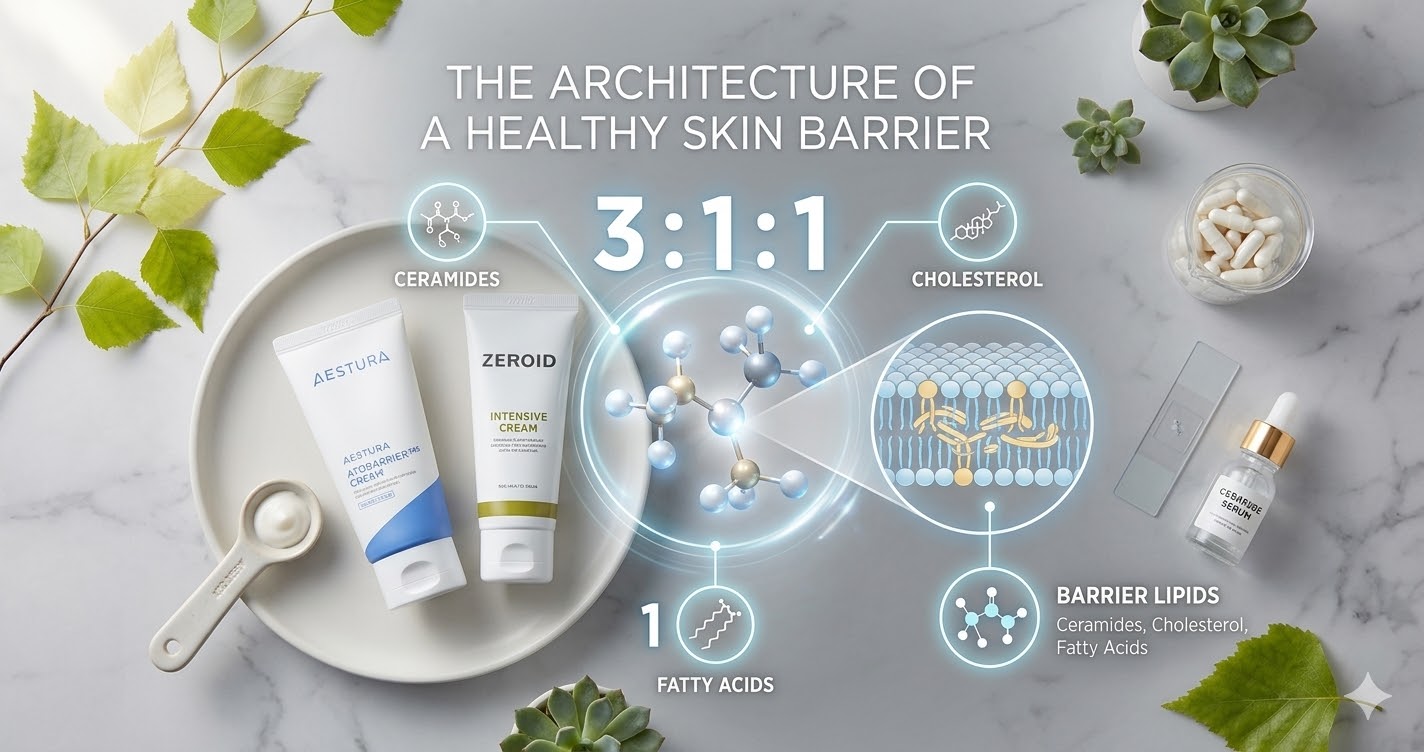
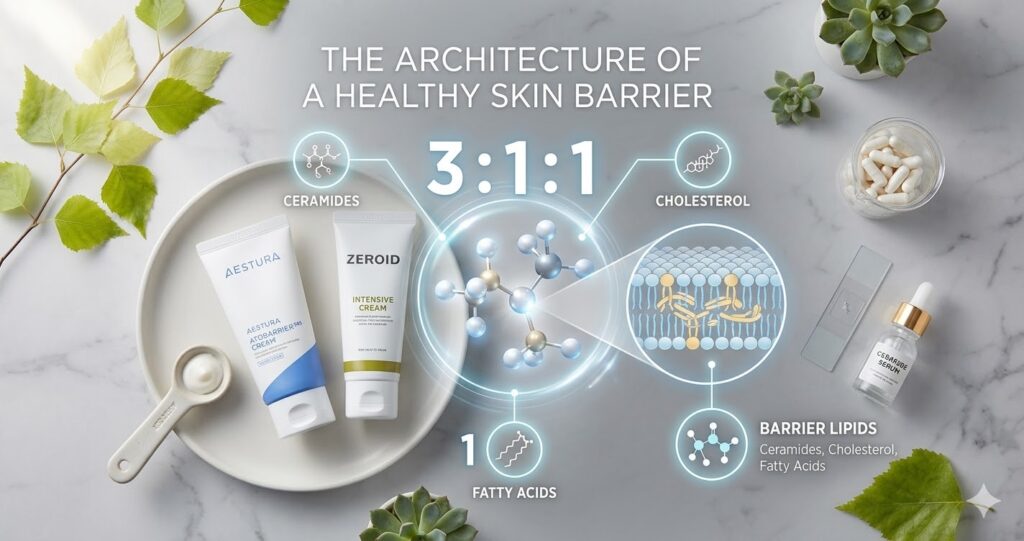
1. Aestura Atobarrier 365 Cream Aestura operates on a national holy grail level alongside Round Lab. This cream utilizes proprietary “DermON” technology, encapsulating the exact golden ratio of lipids found in healthy human skin: Ceramides, Cholesterol, and Fatty acids. While the cream contains visible little capsules, they instantly melt upon contact with the skin’s warmth, delivering a buttery, thick layer of profound healing. If you have dry, mature, red, or chemically damaged skin, this is a non-negotiable purchase.
2. Zeroid Intensive Cream and Lotion If Aestura is the elite, slightly snobbish clinical brand, Zeroid is the highly trusted, down-to-earth neighbor. Relied upon heavily by Korean dermatologists, Zeroid utilizes patented MLE (Multi-Lamellar Emulsion) technology to perfectly mimic the skin’s natural lipid structure. The Intensive Cream is intensely thick, requiring a bit of massage to fully work into the skin, leaving a deeply protective, slightly oily finish that locks in moisture for 24 hours. For those who prefer a milky, buttery texture that is slightly easier to spread, the Zeroid Intensive Lotion is an absolute masterpiece of barrier fortification.
Understanding the subtle differences between global trends and local staples allows you to curate a skincare routine that goes beyond mere hype. By prioritizing elegant textures, gentle soothing, and profound barrier repair, you can achieve that deeply rooted, holistic radiance that defines true K-Beauty.
💡 FAQ :
Q1: What are the key ingredients to look for in a K-Beauty barrier cream, and why are they effective?
A1: The most effective Korean barrier creams, such as Aestura and Zeroid, formulate their products around a specific lipid matrix consisting of Ceramides, Cholesterol, and Fatty Acids. This trio is crucial because it perfectly mimics the natural composition of the human skin barrier. When applied, these ingredients seamlessly integrate into the stratum corneum, instantly repairing micro-tears, preventing transepidermal water loss, and deeply soothing laser-treated or chemically damaged skin.
Q2: Can daily use of exfoliating toner pads cause side effects on the skin?
A2: Yes, while exfoliating pads containing AHA (Alpha Hydroxy Acids) and BHA (Beta Hydroxy Acids) are excellent for clearing clogged pores, excessive daily use can lead to severe side effects. Over-exfoliation strips away the skin’s protective acid mantle, resulting in increased sensitivity, redness, stinging upon applying other products, and paradoxical oil overproduction as the skin desperately tries to hydrate itself. It is recommended to limit exfoliating pads to 1-2 times a week and opt for thick, essence-soaked soothing pads (like Skinfood’s Carrot Carotene pads) for daily use.
Q3: How exactly should hydrogel sheet masks be used compared to traditional paper masks?
A3: Traditional paper or cotton masks should only be left on for 15 to 20 minutes; if left on until they dry out, they will actually draw moisture back out of your skin through reverse osmosis. Hydrogel masks, like the Biodance line, are structurally different. They are composed entirely of solidified essence that slowly melts into the skin upon contact with your body heat. These can safely be worn for several hours (often overnight) to achieve profound, deep-layer hydration without the risk of drying out or causing friction-induced contact dermatitis.
🌿 Weekly wellness, health & beauty insights — straight to your inbox
Free subscription · Cancel anytime