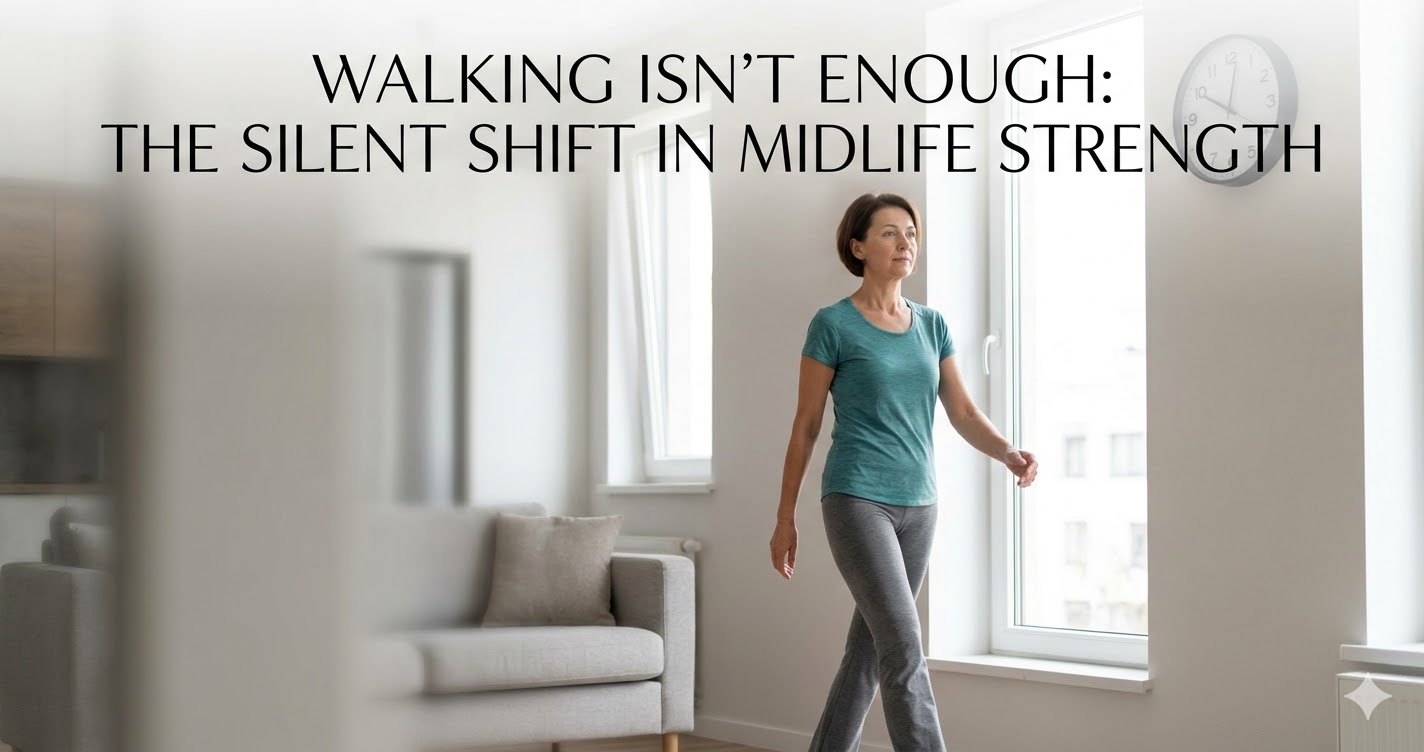
Hitting your 40s and 50s often brings a familiar chorus of health advice. Most people hear the same suggestions repeated like a mantra: “Just walk more,” “Stay active,” “Keep moving,” and you will be fine. On the surface, this sounds completely reasonable. Walking is accessible; it feels safe, and it’s generally easier on the joints than other forms of exercise. Many of us fall into the routine, believing that a daily 30-minute stroll is the definitive answer to the aging puzzle. We assume it is enough.
However, there is a crucial nuance that is almost never explained clearly, and it relates directly to how our bodies actually age during these pivotal decades. While walking is excellent for cardiovascular health and general movement, it does not fundamentally protect your strength during midlife. And midlife—this precise window between your 40s and late 50s—is when your body quietly, but decisively, begins to change.
I remember my own turning point, a moment that echoed the experiences many of you have shared in the Midlife Wellness Hub community. I used to rely almost exclusively on my morning walks, confident I was checking all the necessary wellness boxes. Then, one afternoon, after sitting for a long time, I found myself getting up from a chair and noticed a subtle, unfamiliar lag. My legs felt slightly heavier; stairs that I usually charged up felt more challenging. My energy levels dropped faster than I was used to, despite no change in my routine.
My first thought was typical: “I’m just tired,” or “It’s just the stress of the week.” I assumed it was a temporary, normal part of being busy. But the reality, as I learned later, was different. It wasn’t just ‘normal aging’—it was the initial stages of adaptation.
After our early 30s, the human body slowly starts losing muscle mass and overall bone strength, a process known to health professionals as sarcopenia. This isn’t a disease; it is an adaptive response. If you don’t use your muscles in a purposeful, challenging way that tells them, “I still need you for stability and powerful movement,” your body assumes that maintaining that muscle mass is energy-inefficient. Your structure shifts quietly, affecting your balance, posture, and confidence before you even feel significant pain or injury.
Here at Midlife Wellness Hub, our philosophy is rooted in building proactive strength—addressing these invisible structural changes long before they manifest as chronic problems. The good news is that preventing and reversing this shift is entirely realistic. You do not need a gym membership. You do not need heavy weights or extreme workouts. You simply need the right movements—simple, controlled motions that explicitly tell your muscles and bones, “We are not finished yet.”
Let’s start with a foundational area that most people ignore—calf strength. Your calf muscles at the back of your lower legs are vital far beyond just walking. They are known to function as your second heart, as they help push blood back up toward your heart against gravity. They crucial for overall circulation and venous return.
Calf muscles are equally important for balance and stability. They help you feel steady when you walk or stand and respond quickly to surface changes. When these muscles get weak—a subtle shift that many blame on “achier joints”—your legs feel heavy, your ankles feel stiff, and your balance slowly gets worse.
One of the easiest and most effective ways to keep these muscles strong is with seated calf raises.
The Seated Calf Raise: A Simple Move for Longevity
To begin, find a simple chair in your home where your feet can rest flat on the floor with your knees at about 90 degrees.
- Sit upright.
- Slowly lift your heels as high as they can go, while keeping your toes and the balls of your feet on the ground.
- Hold that squeeze at the top for 2 full seconds. This brief pause is essential.
- Crucially, lower your heels back to the ground with control—this slow lowering part builds more functional strength than people realize.
You should feel the calf muscles tightening. Start with about 15 repetitions, and as you get comfortable, increase to 20 or 25 repetitions. You can even do this while watching TV or working at a desk, which makes it incredibly simple to integrate into your day. This basic movement directly supports circulation, venous health, and leg stability, all of which are critical indicators of confidence and wellness in midlife.
Activate Your Quad Power: Mastering the Seated Leg Extension
Next, let’s focus on the muscles that help you stand up and move with conviction—the large quadriceps (or thights). If you find yourself pushing up off a table to stand or holding the railing tightly while climbing stairs, it is likely due to quad weakness.
Walking barely uses these muscles for propulsion or stability; it primarily requires cardiovascular fitness and joint mobility, not powerful, eccentric quad control. This mismatch explains why many people who walk everyday still feel uncharacteristically weak when standing up after an hour of sitting.
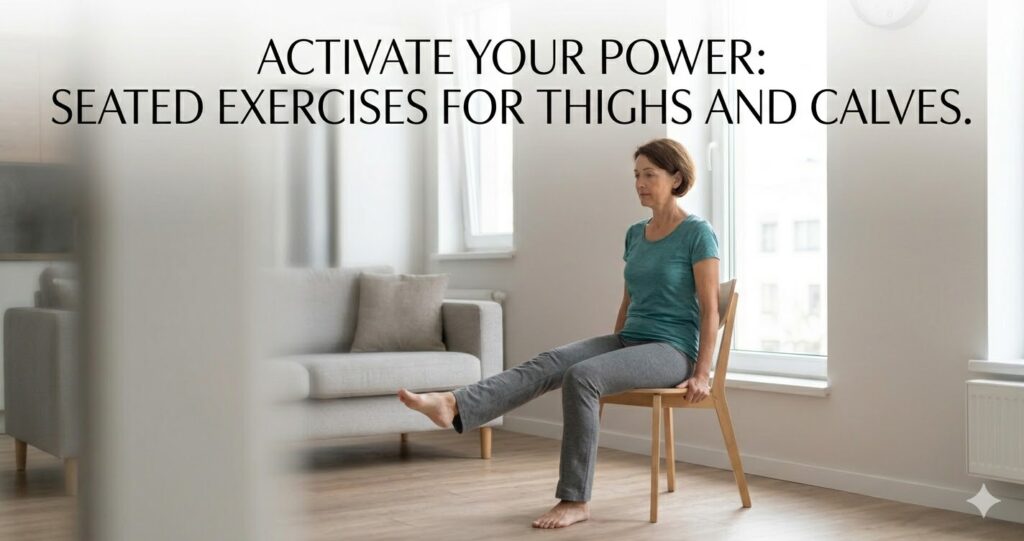
We can address this precisely with a seated leg extension from the same simple chair.
- Sit upright in the chair, aligning your posture.
- With your leg bent at a 90-degree angle, slowly straighten one leg in front of you until it is fully extended.
- Hold it straight for 2 seconds, squeezing the muscle at the front of your thigh (the quad) strongly.
- Lower it back to the starting position with absolute control, ensuring it takes at least 2 full seconds to reach the ground. This eccentric control is what builds lasting strength in midlife.
- Pause for a second, then repeat. Do 10 to 12 repetitions per leg. Rest, then repeat the set.
That feeling you get during the hold is your muscle “waking up” and signaling that it is still needed for functional strength.
We often hear that balance is just an unavoidable part of midlife. But what is often happening is that your hip muscles are weakening quietly. These muscles lift your legs with every single step you take. When they are not strong, your body automatically adapts to avoid a fall. Steps become shorter. Your feet do not lift as high off the ground. A “midlife shuffle” begins, and tripping becomes much easier, which can have significant consequences.
This silent transition isn’t aging; it’s a loss of functional capability in the hips and glutes. To counteract this, we can work these muscles specifically from the safety of your chair.
The Seated Knee Lift: Essential Midlife Mobility
This movement is incredibly simple but effectively targets your hip flexors and core.
- Sit toward the front of your chair with your back straight.
- Slowly lift one knee up toward your chest, high enough that you feel your hip and lower abdominal muscles engage.
- Hold for a second or two, but do not push through pain.
- Lower it slowly to the starting position with absolute control. Go slow—rushing this movement defeats its purpose.
- Pause for a second, then repeat with the other knee.
Do about 20 total lifts, switching legs each time, which helps improve overall control, balance, and coordination.
A Key Midlife Principle: Building Posture to Protect Your Spine
We often attribute poor posture—rounded shoulders, forward head position, and back discomfort—to “aging.” This is fundamentally incorrect. It is, almost without exception, the result of weak back muscles that can no longer support your skeleton against gravity for hours at a time.
Walking is excellent for joint mobility and cardiovascular health, but it does absolutely nothing for your upper back strength or spinal extension. This explains why many active, fit individuals who walk daily still develop noticeable rounded shoulders and chronic upper back pain that gets worse throughout the day. To fix this, you need pulling movements that explicitly tell those postural muscles, “You are still needed for spinal support.”
The Seated Resistance Band Pull: Your Posture’s Best Friend
This exercise is incredibly effective and only requires a resistance band, which is a simple, inexpensive tool that should be in every midlife home.
- Sit on your chair and place a resistance band around your feet, ensuring it is secure.
- Hold the ends of the band in your hands with some light tension.
- Sit upright, pull your elbows back behind your body, and actively squeeze your shoulder blades together strongly. Think about trying to hold a pencil between them.
- Hold the squeeze briefly, then release slowly to the starting position with absolute control—this eccentric release strengthens the stabilizing muscles most effectively.
- Do not rush. Start with 12 to 15 controlled repetitions.
This targeted pulling movement directly strengthens the muscles that pull your spine upright, which allows you to breathe more deeply, move with greater confidence, and maintain a healthier spinal alignment.
The Most Important Movement of All: The Chair Squat (Sit-to-Stand)
We have now activated key muscles in your legs, hips, and back. It is time to integrate them all with the single most important movement for maintaining functional independence and real-life capability: standing up from a chair.
This movement is a definitive test of your strength, stability, and control. If this feels challenging in your 40s or 50s, consider it a clear warning sign from your body, not a failure. It is simply an adaptation that we are going to reverse.
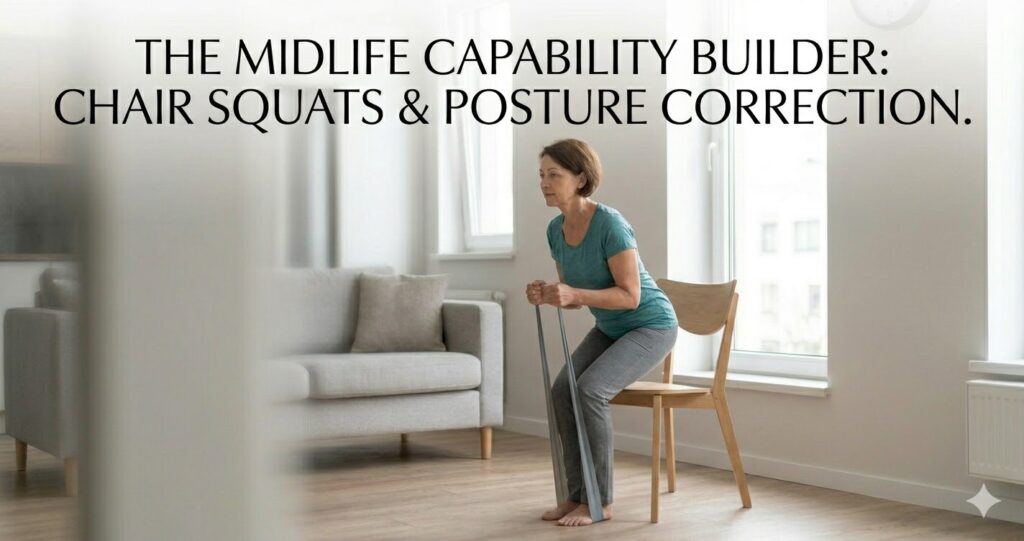
- Sit on your chair and place your feet slightly wider than your hips.
- Lean forward a little. This shifts your center of gravity.
- Stand up using only your legs—do not push off a table or hold the railing. This is key to building capability in the leg and hip extensors.
- The most important part of this exercise—the part that builds the most functional strength—is how you lower yourself back down slowly and with control.
- Pause for a single second at the bottom, then repeat.
Start with about 8 to 10 repetitions, and as you get stronger, increase to 12 or 15. This single movement strengthens your entire leg, hip, core, and bones all at once, improving balance and practical life skill with every controlled rep.
Why Consistency Matters More than Perfection in Midlife
Here at the Midlife Wellness Hub, our goal is to help you build strength in a realistic, safe, and sustainable way. What we are doing isn’t about extreme results; it is about midlife preparation. What you build in these decades decides how strong, mobile, and confident you feel 10, 20, or 30 years from now.
Walking is excellent for your heart, but strength training is what keeps you capable of getting up from the chair and playing with your grandkids, and it reduces your fall risk down the line. We don’t need perfection. We simply need consistency. Just 10 to 15 minutes of these simple movements a few times per week can completely change how your body ages. And the best part? It can be done entirely at home.
Now, I want to hear from you. Which of these movements felt easiest to understand? Which one do you feel your body needs the most? Tell us in the comments. Like this video so others in midlife can see it.
💡 자주 묻는 질문 (FAQ)
Q1: How often should I do these exercises to see results?
A1: Consistency is far more important than intensity. Aim for 10-15 minutes of these exercises 3 to 4 times per week. As you get comfortable, you can gradually increase the sets or repetitions.
Q2: What if I have some joint pain? Can I still do these?
A2: Most of these movements are designed to be low-impact. However, if you experience sharp or unusual pain, stop immediately and consult a health professional. Always focus on maintaining control during the movement, not speed.
Q3: Can I really build muscle mass in my 50s at home without weights?
A3: Yes, absolutely. These controlled, targeted movements, especially with proper eccentric (lowering) control, challenge your muscles sufficiently to prevent sarcopenia (muscle loss) and build functional strength without the need for heavy gym equipment.
🌿 Weekly wellness, health & beauty insights — straight to your inbox
Free subscription · Cancel anytime